Travel Planning & Logistics · Borders
The good news: a US passport opens almost the entire western hemisphere without a visa. The useful news: the exceptions changed recently, the fees hide in odd places, and the rules everyone remembers are a few years out of date.
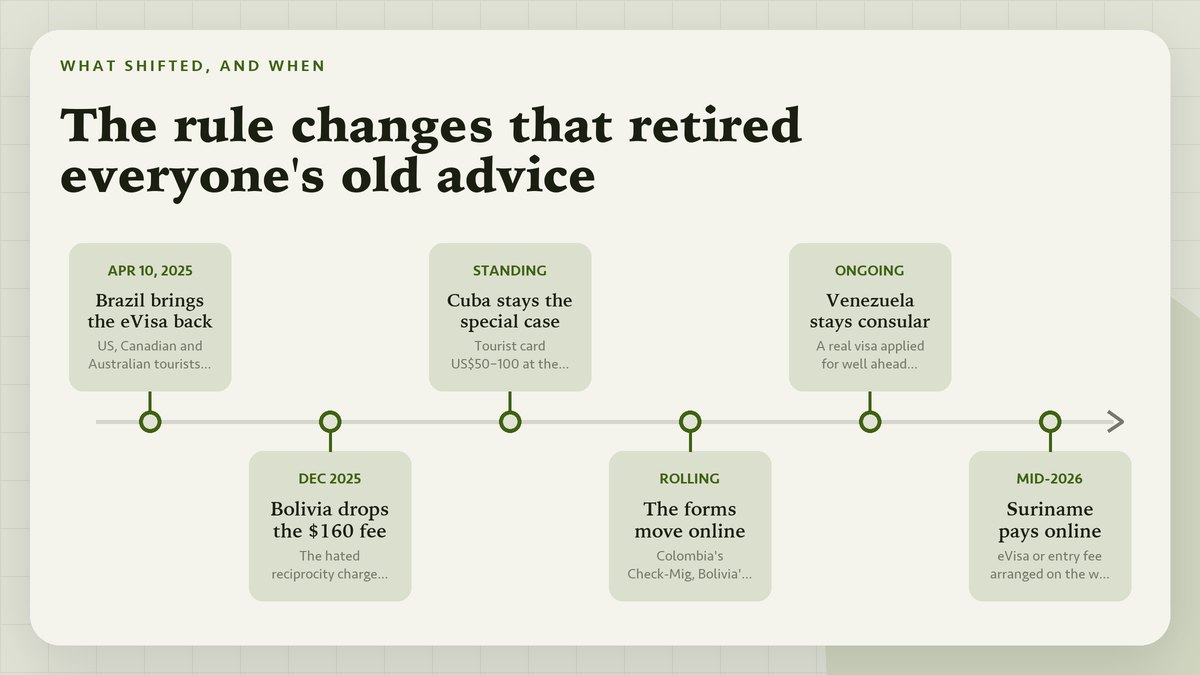
Visa information ages faster than almost anything else in travel. Sometimes within months. The article you read before your last trip is quietly wrong by your next one. Brazil brought its visa requirement back in 2025, Bolivia dropped its hated $160 reciprocity fee the same year, and a handful of countries have shuffled their paperwork online or invented new entry fees since whatever blog post you bookmarked was written. This overview reflects the state of play in mid-2026 and is written mainly for US passport holders, with notes where Canadians and Europeans differ. It also carries the standing order every visa guide should carry, which is to verify your specific situation against official sources before you book. For US travellers, the country-by-country pages at travel.state.gov are the baseline I’d start from.
In this article
- The Big Picture Mostly open, with famous exceptions
- The Headline Changes What shifted in 2025 and still applies
- Country by Country The full board, mid-2026
- The Rules Behind the Rules What actually gets travellers refused
- The Non-US Reader Quick notes for other passports
- A Pre-Flight Ritual Ten minutes, two weeks out
- Extensions, Renewals and Overstays When 90 days isn’t enough
- Land Borders: The Practical Layer Where the rules meet the road
- The Documents That Actually Get Checked Beyond the passport
- Working Remotely: The Grey Zone The question everyone asks
The Big Picture Mostly open, with famous exceptions
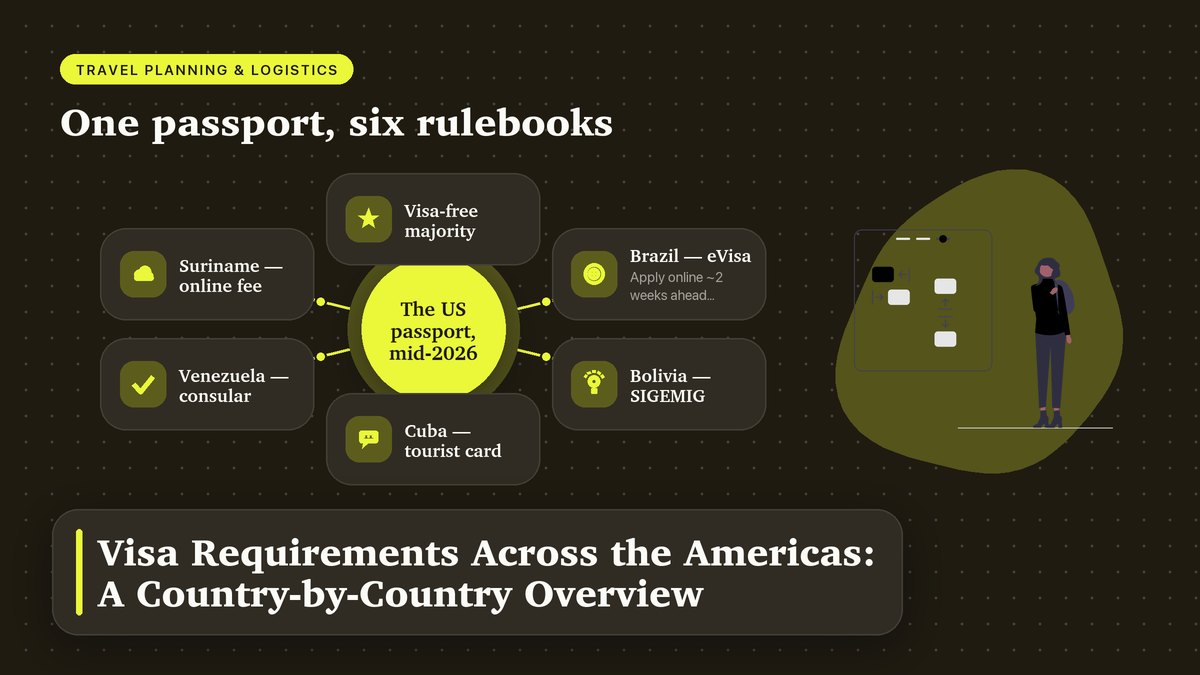
For a US passport, the Americas are one of the easiest regions on the planet for tourists, which is why the exceptions below matter more than the rule itself. The overwhelming majority of countries admit tourists visa-free for somewhere between 30 and 180 days. Stamp, go, no paperwork. The exceptions sort into three buckets, and honestly only a few of them will ever touch your trip. Some countries want an electronic visa or online authorisation arranged in advance, Brazil being the headline. Some want a purchased tourist card or entry fee arranged before you fly, which covers Cuba, Suriname and the odd airport tax that still catches frequent flyers. And one country puts American tourism in a legal category entirely of its own, which is Cuba again, and it gets its own section below because the rules involved are American rather than Cuban. Canada and Mexico, the two destinations most of us actually visit, need no visa at all for US citizens. Mexico does hand you an FMM tourist permit on arrival or online, and you’ve got to keep that slip and surrender it when you leave.
The Headline Changes What shifted in 2025 and still applies
Brazil: the eVisa is back
After six visa-free years, Brazil started requiring visas again for citizens of the US, Canada and Australia on April 10, 2025. The whole process lives online. Nothing to mail. You apply for an eVisa through the government-authorised portal at brazil.vfsevisa.com, pay around US$80.90, and wait roughly five business days on average, though some applications clear faster and some slower, which is why the buffer below matters. The eVisa usually arrives with multi-year validity and allows stays of up to 90 days per entry, extendable in-country to 180 days per year. Two operational details matter more than the fee. Apply at least two weeks before departure so you have margin if they ask for extra documents, and print the PDF, because airlines check it at boarding and have refused people over its absence. EU, UK, Japanese and most Latin American passports are still exempt.
Bolivia: the $160 fee is gone
For decades, Bolivia charged US citizens a $160 reciprocity fee for a visa on arrival, which made it the most expensive welcome mat in the Americas. That era ended in December 2025, when Bolivia moved the US, UK and EU countries onto its visa-free list for tourism stays of up to 90 days. Good news for the wallet. The friction now is administrative instead of financial. Every foreign visitor has to complete the SIGEMIG online pre-registration before arrival. It is free, it runs through the official migration portal, and skipping it is currently the main cause of airport delays at El Alto. Because the change is this recent, I’d confirm the current rules before travel, since land-border implementation of new policies in the region sometimes lags the announcement by months.
Cuba: the special case for Americans
Every visitor to Cuba needs a tourist card. Airlines often bundle it, or you’ll buy it at the departure gate for roughly US$50 to 100 depending on the route, and that part is the Cuban requirement, which is simple. On paper, simple. The complication for US passport holders is American law, not Cuban law. US regulations prohibit tourism and require travel under one of twelve authorised categories, the one most people use being “support for the Cuban people,” which shapes where you sleep and where your money goes. This guide can’t adjudicate US law. What it can say is that the Cuban paperwork takes about ten minutes, maybe less, and the US compliance question deserves the serious research before you book.
Country by Country The full board, mid-2026
| Country | Requirement | Typical stay | Notes |
|---|---|---|---|
| Canada | Visa-free | Up to 6 months | Passport required; no eTA for US citizens |
| Mexico | Visa-free + FMM permit | Up to 180 days (at officer’s discretion) | Keep the FMM; surrender on exit |
| Central America (all 7) | Visa-free | 90 days (CA-4: Guatemala, Honduras, El Salvador, Nicaragua share a single 90-day zone) | Panama, Costa Rica & Belize separate; CR may require onward ticket |
| Cuba | Tourist card | 30–90 days | US-law categories apply to Americans |
| Colombia | Visa-free | 90 days, extendable to 180/yr | Check-Mig online form before flights |
| Ecuador | Visa-free | 90 days | Includes Galápagos (separate transit card & park fee) |
| Peru | Visa-free | Up to 90 days | Stamp-free e-gates at Lima for some; keep entry record |
| Bolivia | Visa-free since Dec 2025 | 90 days | SIGEMIG pre-registration mandatory |
| Chile | Visa-free | 90 days | Reciprocity fee abolished years ago |
| Argentina | Visa-free | 90 days | Reciprocity fee abolished; no advance paperwork |
| Brazil | eVisa required | 90 days per entry | Apply online ~2 weeks ahead; print the PDF |
| Uruguay / Paraguay | Visa-free | 90 days | Among the simplest entries on the continent |
| Venezuela | Visa required | Varies | Apply via consulate well ahead; check advisories |
| Suriname | eVisa / entry fee online | Up to 90 days | Pay online before travel |
| Guyana / French Guiana | Guyana visa-free; French Guiana = France (Schengen rules) | 30–90 days | FG follows EU rules for non-EU passports |
The Rules Behind the Rules What actually gets travellers refused
Passport validity first. The six-months-beyond-entry rule gets enforced patchily across the Americas, but it’s real, and several South American countries state it on paper while airlines apply it at check-in even when border officers wouldn’t have. My own rule is to renew at nine months remaining. Nine months, not six. Do it early, basically, and the whole question stops existing.
Onward tickets get enforced more often than visas in this region, which surprises people. Costa Rica, Panama and others formally require proof of onward travel, and airlines check more diligently than immigration does, mostly because carriers pay to fly refused passengers back. The fix is cheap. A flexible or refundable onward booking solves it.
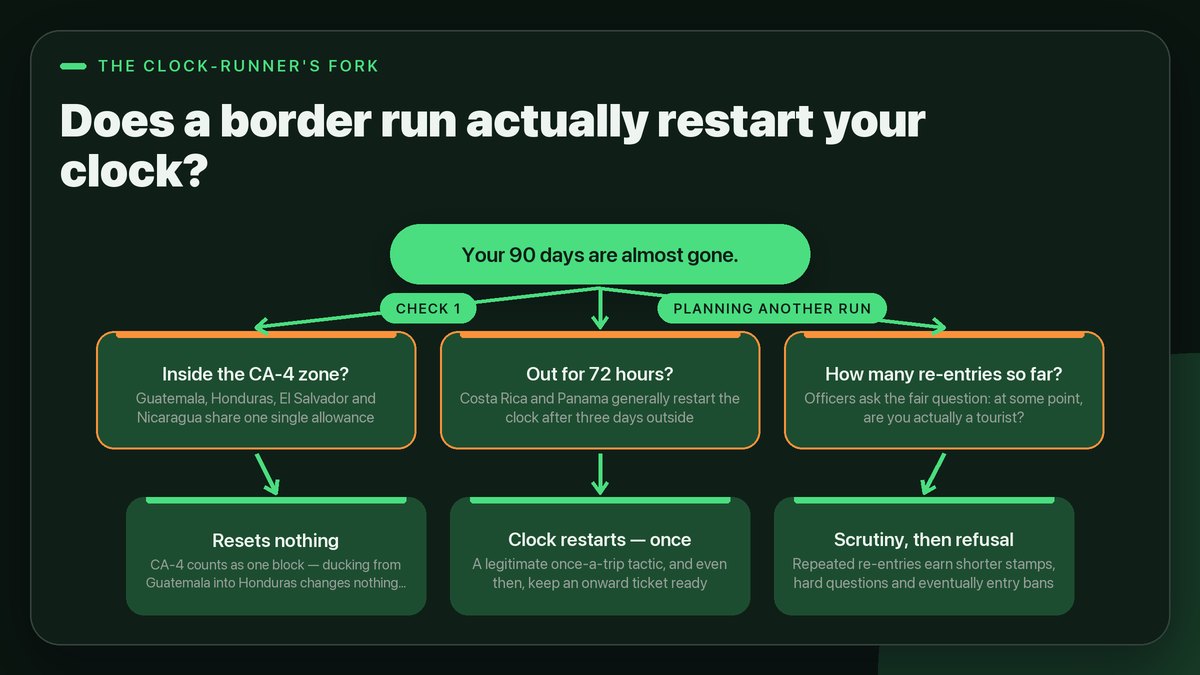
Most South American countries stamp you in for 90 days, extendable to 180 per calendar year. Long-term travellers respond with the visa run, hopping a border to restart the clock. It only half-works. The CA-4 zone in Central America counts Guatemala, Honduras, El Salvador and Nicaragua as one block, so crossing from Guatemala into Honduras resets nothing at all. To actually restart the clock you’ve got to leave the zone entirely.
Entry and exit fees come next. The Americas mostly buried their old airport departure taxes in ticket prices, but exceptions survive. Cash still rules at some crossings. Some Caribbean states and the occasional Latin American airport still charge separately, and land borders in Central America collect small entry and exit fees payable in cash. Keep small US bills for exactly this. Dollars work at borders throughout Central America, and Ecuador uses the dollar outright.
Yellow fever certificates aren’t a visa, but they sit right next to one. Bolivia, Colombia for some arrivals, and Brazil’s neighbours in both directions want proof of vaccination when you arrive from risk areas, and a few jungle regions recommend or require it outright. The card weighs nothing. Carry the yellow card, because some posts check it more diligently than they check passports.
The Non-US Reader Quick notes for other passports
Canadian and EU passports track the US position closely across the region, with two standing differences. Brazil’s eVisa currently covers Canadians and Australians alongside Americans, while most EU states are exempt. Cuba’s category restrictions exist only in US law, so a Canadian tourist just buys the card and goes. UK, Australian, Japanese and most Latin American passports enjoy similar visa-free coverage. Whatever passport you carry, pair your own government’s travel-advice site with the destination’s consulate page for verification. Third-party visa-checking websites lag policy changes by weeks to months, which in this region is sometimes the entire life of a policy.
A Pre-Flight Ritual Ten minutes, two weeks out
Two weeks before any trip in the Americas, I run the same loop, and it takes about ten minutes, maybe less. Check each destination on the official travel site, which for the US means the country pages at travel.state.gov. Search the destination’s own migration or consulate page for entry requirements, because the home page never shows them. Confirm the passport runs six months past the entry date. Fill in whatever pre-registration exists, Brazil’s eVisa, Bolivia’s SIGEMIG, Colombia’s Check-Mig. Print it all out. Approvals, onward tickets, first-night accommodation, since a phone at 2% battery isn’t a document and border desks have no sympathy for a dead screen. And photograph the passport into cloud storage. Ninety seconds of work, and it has saved more trips than any insurance policy I’ve bought. Visa drama in the Americas is almost never about visas. It is a form nobody mentioned, discovered at a check-in desk, and the ritual above is how you never meet it.
Extensions, Renewals and Overstays When 90 days isn’t enough
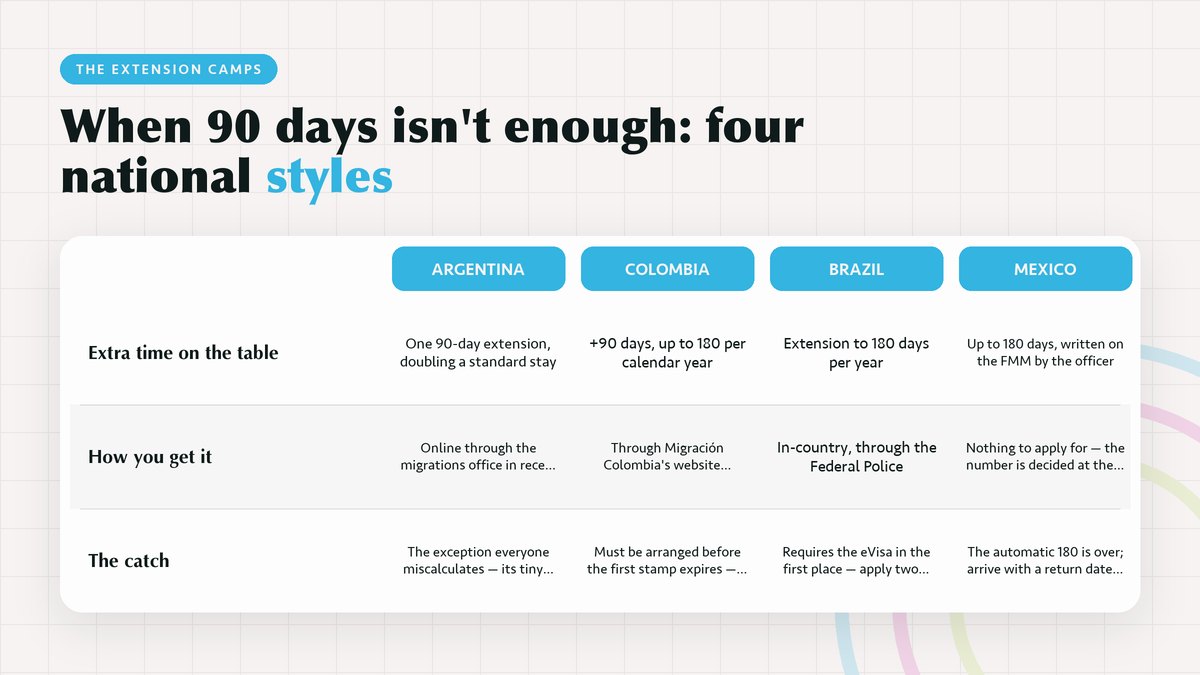
Ninety days sounds generous until you fall for a place in week eleven. Three camps, more or less. Argentina is the easy case, with one 90-day extension through its migrations office, handled online in recent years, for a modest fee. Colombia lets you add 90 days through Migración Colombia’s website without you leaving your hammock, which is more or less the point of Colombia. Brazil allows extension to 180 days through the Federal Police. Mexico sits in the discretionary middle. The FMM technically allows up to 180 days, but the number is written by the officer at the desk, and the era of the automatic 180 is over. Many travellers now receive exactly the number of days their itinerary justifies, so it pays to arrive with bookings, a rough route and a return date that show a plan. Peru is effectively fixed and hasn’t routinely granted tourist extensions in recent years. What you are stamped in with is what you have.
The classic workaround, the border run, still exists, though it’s living on borrowed time. Leaving Costa Rica or Panama for 72 hours and returning generally restarts the clock. CA-4 counts as one. Ducking from Guatemala into Mexico does nothing at all, because the CA-4 countries share one allowance between them. The run that works is out of the zone entirely. And everywhere officers now ask the fair question. If you’ve done this three times, are you actually a tourist? Repeated re-entries invite scrutiny, shorter stamps and eventually refusal, probably in that order. Treat the border run as a once-a-trip tactic and nothing more.
Overstaying is the bad option wearing a free disguise. Fines across the region typically run a few US dollars per day, payable at the airport, often in cash, sometimes at a special desk while your flight boards. The record can complicate future entries, particularly in Ecuador, Colombia and the CA-4. Argentina is the exception everyone miscalculates, because its overstay fine is famously modest and payable on exit, which has bred a generation of Buenos Aires long-stayers treating it like a parking ticket. It works until it doesn’t, repeat overstays have produced entry bans. Pay the extension instead. Where one exists, buy it, because the fee is always cheaper than the problem.
Land Borders: The Practical Layer Where the rules meet the road
Most border trouble in the Americas is procedural rather than political, and it concentrates in a few predictable places. The exit stamp comes first. The region runs on paired stamps, meaning you must be stamped out of one country before the next will stamp you in. At major crossings this happens automatically. At small ones, the Bolivia–Chile desert posts, the Guatemala–Belize crossing at Melchor, river borders in the Amazon, finding the migration window is your job, and it may sit a kilometre back from the actual line. Travellers who skip it discover the omission days later, when the next country’s system shows them as never having left, and the fix involves going back. I put “get the exit stamp” on my crossing checklist right next to fuel.
Borders keep hours too. The big ones, Tijuana–San Diego, the Paso de Los Libertadores tunnel between Argentina and Chile, run around the clock or near it. Andean and Amazonian posts commonly close overnight, and weather shuts the high passes entirely, with Los Libertadores and the Paso de Jama closing for snow on little notice in winter. Never plan a same-day flight after a land crossing. And never arrive at a remote border at dusk, which is the mistake I watch people make more often.
The vehicle is its own chapter. Driving your own car across the Americas means collecting a temporary import permit for each country and cancelling it on exit, every time, without exception. Cancel it every time. Fly home from Bogotá with an uncancelled Colombian TIP and the system believes your vehicle never left, which translates to fines and impoundment risk waiting at the next entry. Photograph every cancellation receipt. Cash helps here as well, since small official fees, the FMM payment, Belize’s exit fee and assorted border charges are cash-only in dollars or local currency, and the moneychangers at the line know exactly how captive you are. Change the minimum, at a rate you’ve checked on your phone in front of them.
The Documents That Actually Get Checked Beyond the passport
Oddly, the passport is the least-checked document in your stack, and what airlines and officers actually ask for, in rough order of frequency, is this.
Proof of onward travel is the region’s real gatekeeper. Airlines enforce it at departure check-in because carriers pay to fly back anyone refused entry. Costa Rica, Panama, Colombia, Peru and Brazil all carry onward-ticket rules on paper, and enforcement wanders by season. The big regional carriers ask often enough that a refundable or cheap throwaway ticket out is standard equipment for one-way travellers. A bus ticket to the next country satisfies the requirement across most of Central America, which is worth knowing when the cheapest onward flight costs more than your whole week.
Then come the entry forms. The forms cost nothing. Colombia’s Check-Mig is free, online, and completed within 72 hours of the flight. Bolivia’s SIGEMIG pre-registration is free and has been mandatory since the December 2025 visa change. Brazil wants the printed eVisa approval, Cuba wants the tourist card plus an advance traveller form, and the US ESTA applies to visa-waiver travellers heading north. None of these is a visa, and every one of them can stop a boarding pass. They behave like speed bumps, invisible until you hit one.
Health documents sit in the same stack. The yellow-fever certificate is demanded by a rotating cast of countries when you arrive from endemic zones, and travellers moving from the Colombian or Peruvian Amazon toward Central America get asked. Jungle itineraries need the card. Carry the yellow card on any itinerary that touches jungle. Prescriptions should travel in original packaging, and a doctor’s note for anything injectable or controlled saves long conversations at land borders.
And the quiet ones that surface only at the desk. Arrival forms demand an accommodation address for the first night, and “the hostel with the green door” does not parse. Cuba officially requires travel insurance and occasionally checks. Renters, take note. An International Driving Permit is technically required alongside your licence in Brazil and much of South America, rarely asked for until the traffic stop where it suddenly matters. Then the blanket rule, six months of passport validity past your entry date. Some countries legally require only validity for the length of your stay, but airlines apply six months as a blanket rule. The airline is the border you meet first.
Working Remotely: The Grey Zone The question everyone asks
Can you answer email from a Mexican beach on a tourist permit? As a practical matter, the entire remote-working world already does, and no country in the region has shown any appetite for policing laptop use by tourists. As a legal matter, tourist status everywhere forbids “work,” a term written for a pre-laptop era. My honest summary is that enforcement risk for serving clients back home sits at effectively nil, while the rulebook technically says otherwise. The line is local money. What clearly crosses it is taking local clients, being paid locally, or working on-site for a local company. That’s work-permit territory in every country, and it’s the version that actually gets enforced.
If the trip stretches into seasons rather than weeks, the region now offers the honest route, which is the digital-nomad visa. Do the maths first. Costa Rica, Colombia, Brazil, Argentina, Ecuador and Uruguay all run programs as of 2026, typically asking proof of roughly US$1,500 to 3,000 in monthly foreign income and granting a year or more, often renewable. Mexico’s temporary-residency route serves the same crowd. Fees run a few hundred dollars and processing takes weeks to months, but the visa converts the grey zone to white, and in several countries it’s also the simplest path to a bank account and a lease. If your plan is a season rather than a holiday, price the visa. It costs less than three border runs and feels far more comfortable at immigration.
Entry policies summarised here were verified against official sources in August 2026, including the US State Department and the Brazilian government’s authorised eVisa portal, and they can change without notice. Treat this article as general information rather than legal advice. Fees are approximate and vary by exchange rate and nationality. This article contains no affiliate links. All outbound links checked live in August 2026. Verify before booking.