Travel Planning & Logistics · Money
Every long-trip plan eventually becomes a spreadsheet, and every spreadsheet eventually meets a country that laughs at it. Realistic monthly budgets for twelve destinations across the Americas — backpacker and mid-range — with the traps that break them.
The question sounds simple. “What does a month in South America cost?” The honest answer is a shrug, then a spreadsheet. The same traveller can spend $800 in Bolivia and $4,000 in the United States in back-to-back months and feel equally comfortable in both. What follows are realistic 2026 budgets for twelve countries across the Americas, built the way experienced long-term travellers actually build them. Two tiers, backpacker and mid-range. All-in daily costs. And the local quirks that generic cost-of-living sites never capture, the currency games, the park fees, the flight traps that ambush a tidy plan.
First, the methodology, because numbers without definitions are astrology. Backpacker tier means dorm beds or basic private rooms, street food and market lunches with one sit-down meal, buses over flights, free and cheap activities. Mid-range tier means private double rooms, counted per person and shared, restaurant meals, the odd domestic flight or rental car day, and paid tours and entries. Both numbers exclude international airfare and travel insurance, and both assume a sane pace, because how often you move is the single biggest budget variable in any long plan. For live comparison data while you plan, Numbeo‘s crowd-sourced cost database is the standard cross-check. I lean on it mostly to sanity-check food and lodging lines before a trip, and so far it hasn’t steered me wrong.
In this article
- The Twelve, Cheapest to Dearest Monthly totals, per person
- The Cheap South Where a day is a good life
- The Middle Band Where choices, not prices, decide the month
- The Expensive End Costa Rica, Chile, and the north
- The Seven Budget Traps Where months actually break
- Building Your Own Number The honest formula
- Where the Money Actually Goes Category by category
- Money Mechanics Cards, cash and ATM craft
- Three Sample Months What the tiers look like from inside
The Twelve, Cheapest to Dearest Monthly totals, per person
| Country | Backpacker / month | Mid-range / month | The budget-breaker to watch |
|---|---|---|---|
| Bolivia | $700–1,000 | $1,400–2,000 | Uyuni tours & jungle flights |
| Guatemala | $800–1,100 | $1,500–2,200 | Tikal add-ons; Antigua’s gringo prices |
| Ecuador | $900–1,200 | $1,600–2,400 | Galápagos (its own budget universe) |
| Peru | $900–1,300 | $1,700–2,500 | Machu Picchu logistics; Inca Trail |
| Colombia | $900–1,300 | $1,700–2,500 | Domestic flights; Cartagena’s walled-city premium |
| Mexico | $1,000–1,500 | $1,900–2,800 | Beach-corridor prices vs. interior reality |
| Argentina | $1,000–1,500 | $1,900–2,900 | Exchange mechanics; Patagonia’s south |
| Brazil | $1,100–1,600 | $2,000–3,000 | Rio’s beachfront; Carnival week |
| Costa Rica | $1,400–2,000 | $2,600–3,800 | Park fees and tour prices add up fast |
| Chile | $1,400–2,000 | $2,500–3,700 | Patagonia logistics; rental cars |
| Canada | $2,200–3,000 | $4,000–6,000 | Car dependence; Rockies accommodation |
| USA | $2,400–3,400 | $4,500–7,000 | Cars, cities, and tipping culture |
The Cheap South Where $35 a day is a good life
Bolivia is still the hemisphere’s budget monarch. Dorm beds under $10, set lunches (almuerzos) at $2–3 that would run $15 in Santiago, intercity buses priced for locals. The splurges are activity-based, mostly the three-day Uyuni salt-flat circuit and a pampas tour out of Rurrenabaque, and even those are gentle by regional standards. A month here is where most people’s mental math about South America gets formed, and honestly it barely strains a US$1,000 budget even if you say yes to every tour that finds you. Guatemala runs close behind, with one caveat worth knowing. The traveller trail, Antigua and Lake Atitlán, is a price island where boutique hostels and cafés charge near-US numbers, while the rest of the country stays cheap. Ecuador and Peru sit in the same band, both carrying big asterisks. Ecuador’s mainland is a bargain, but the Galápagos multiplies everything by three, park fee, transit card, island prices. Peru’s headline attractions can add $300–800 to a month that otherwise runs on $6 menús del día, once you price Machu Picchu entry, the train, the shuttle, and the Inca Trail’s guided-trek requirement. Colombia rounds out the budget five. Buses, finca stays and set lunches are exceptional value, domestic flights stay cheap if you book a few weeks out, and Cartagena’s walled city is priced like the resort it has become.
The Middle Band Where choices, not prices, decide the month
Mexico, budget-wise, is two countries. The interior, the colonial cities, Oaxaca, the Bajío, runs comfortably at the cheap end. The Riviera Maya and Los Cabos corridors run at Florida prices, and Tulum has passed them. If you mix the two, budget the coast days at roughly triple the interior days. The math isn’t subtle. Argentina is the continent’s moving target. Years of inflation and currency experiments have made it alternately punishing and absurdly cheap for dollar-holders, and the payment mechanism, card rates, cash exchange, ATM withdrawals, has repeatedly shifted real prices by 30–50%. As of mid-2026 it sits in the middle band. Superb value in the north and the wine country, pricier down in Patagonia. But check the exchange mechanics the month before you fly; Argentina rewards the informed and taxes the unprepared. Brazil prices like what it is, a large middle-income country. Cheap lunches and buses, domestic flights that double when booked late, and Rio’s beachfront accommodation at international prices all year, with Carnival week sitting in a bracket of its own.
The Expensive End Costa Rica, Chile, and the north
Costa Rica shocks people who assume Central America is uniformly cheap. It’s priced for the North American eco-tourist. National park entries run $15–18, guided-tour culture is the default, and restaurant prices wouldn’t raise an eyebrow in Florida. Nothing subtle about any of it. You can travel it on a budget, public buses, sodas, the free beaches, but the famous experiences, hanging bridges, night tours, ziplines, charge famous prices. Chile is South America’s most developed economy and charges like it, Santiago aside. Patagonia stacks costly buses, park fees and refugio beds into the continent’s priciest southern month, though camping and self-catering claw much of that back. Canada and the USA live in another universe. The car is effectively mandatory outside a handful of cities, and accommodation floors are high. A basic US motel room runs $80–130 across most of the country, double that in park towns in season, and the US adds tipping at 18–20% on table service plus sales taxes quoted after the sticker price. Road-tripping the US cheaply is a real skill: campgrounds, motel chains, supermarket picnics. And the national parks pass. Plan for it, or it plans for you.
“The single biggest budget variable isn’t the country. It’s how often you move. Slow travel is cheap travel — everywhere on the map.”
The Seven Budget Traps Where months actually break
1. Moving too fast. Every relocation day costs a bus or flight, a terminal meal, and a first-night premium in a new place. People who move every two days spend roughly 40–60% more than people who stay a week, and they see less doing it, which is the part that stings. Weekly rental discounts and market self-catering are the compounding interest of slow travel. It compounds.
2. The headline-attraction stack. Machu Picchu, Galápagos, Torres del Paine refugios, Rio at Carnival, the Canadian Rockies in July: every region keeps one anchor experience priced at multiples of the surrounding country. Treat each as a separate project with its own budget, rather than a line item in the daily spend.
3. Currency mechanics. Argentina’s exchange question is the extreme case, but the quieter tax hits everywhere. Flat foreign-transaction fees plus local ATM charges punish small frequent withdrawals, so pull larger amounts less often, on a no-foreign-fee card, and hold a cash buffer.
4. Seasonal whiplash. Accommodation doubles or triples in high season at beach and park destinations. Think December–February in the southern summer, July–August in the north, Easter week anywhere Catholic. Shoulder seasons are the budget traveller’s best friend, and often the best weather anyway.
5. Tours you didn’t price. Amazon lodges, salt-flat circuits, the glacier ice-trek, the ATM cave: the region’s best experiences are guided by necessity and priced accordingly, and a month of “cheap” countries can easily hide $500 of tours. List yours before you fly; landing is too late.
Drink budgets: Nobody’s spreadsheet includes the bar tab, everybody’s month does.
7. The first and last weeks. Arrival weeks overspend on jet-lagged convenience, deposits, and gear gaps, and departure weeks somehow manage the same trick. Pad both by 20%.
Building Your Own Number The honest formula
Take the table as your base, then adjust for the multipliers that actually apply to you. Fast movers should add about 40%. High season at anchor destinations adds 30–100% on accommodation. Couples sharing rooms cut the mid-range tier by a quarter per person, kitchen access halves food costs in expensive countries and matters less in cheap ones, and your tour list does whatever it does. Cross-check current city prices on Numbeo as your dates approach. It’s ten well-spent minutes. The two honest constants in regional budgeting are that cheap countries stay cheap, and everything else moves.
One closing observation, offered by basically everyone who’s done a long Americas trip: the cheapest countries, Bolivia, Guatemala, Ecuador, Peru, Colombia, are no consolation prize. They’re the months people remember most fondly. Partly that’s because a $3 lunch eaten at a market counter with the people who grew the potatoes beats a $30 lunch in a country where the view is what you can’t afford. Budget for the expensive anchors, linger in the cheap heartland, and the hemisphere pays for its own surprises.
Where the Money Actually Goes Category by category
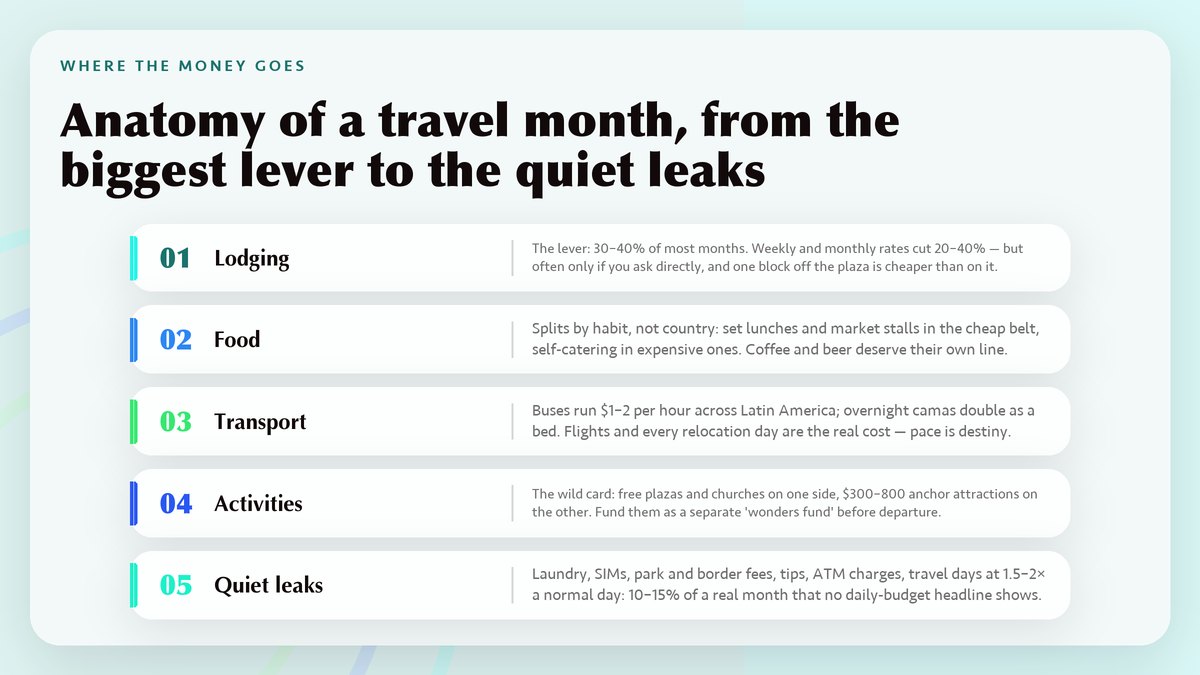
Lodging is the lever. It’s the biggest single line for nearly everyone, typically 30–40% of a month, and the one with the widest range. A dorm bed runs US$8–15 across the cheap belt, US$20–35 in Mexico and Costa Rica, and US$40–70 in big US and Canadian cities. The discounts that matter aren’t on booking sites. Weekly and monthly rates knock off 20–40%, often only if you ask directly, low-season walk-in negotiation still works in much of the region, and staying one block off the plaza instead of on it quietly cuts the rate. And couples should do the arithmetic too, since two dorm beds frequently cost more than one private room.
Food splits by habit, not by country. The same month in Peru can cost US$200 or US$700 depending on a single decision, whether lunch is the menú del día (US$2–5 across the Andes, Mexico’s comedores, Brazil’s per-kilo buffets) or the gringo-trail café. Self-catering halves food costs in expensive countries and saves surprisingly little in cheap ones, where the market stall and the set lunch are already priced for local wages. Most long travellers I know land on the same pattern eventually. Markets and set lunches on weekdays, restaurants as events, and coffee and beer tracked as their own line because they have a way of becoming one.
Transport: pace is destiny. Long-distance buses run roughly US$1–2 per hour of travel across Latin America, and the overnight cama services double as a night’s bed, which is its own small mercy on a month-long itinerary. Budget airlines like Viva and JetSmart undercut buses on long legs when booked weeks ahead, then cost double the headline once bags and seat selection join in. Domestic flights are the distortion nobody plans for. Brazil, Argentina, Colombia and Canada are each big enough that “we’ll just fly that bit” can add US$100–300 to a month. And every move costs a day as well as a fare, station taxis, terminal food, the arrival-night premium room, all of it small and none of it optional, which is exactly how a cheap bus ticket becomes the priciest decision of the week. Slow travellers don’t just see more. They spend less by structure.
Activities are the wild card. Walking, plazas, markets, beaches and half the region’s churches are free, while the headline attractions are anything but. Machu Picchu with train and guide, the Inca Trail, a Galápagos cruise, Torres del Paine refugios, an icefield walk, Carnival accommodation. My preferred trick is the “wonders fund”, a separate envelope funded before departure, so the US$700 trek doesn’t ambush the US$40 daily budget. The alternative, watching the anchor of your whole trip from the cheap seats to protect a spreadsheet, is the one economy travellers consistently regret.
The quiet leaks. Laundry, SIM cards and data (US$10–20 a month per country if you buy local), national-park and border fees, tips, ATM charges, gear replacement, and travel days, which reliably cost one-and-a-half to two times a normal day. None of it shows up in a “daily budget” headline. Together these run 10–15% of a real month, so give them a line or they’ll budget themselves.
Money Mechanics Cards, cash and ATM craft
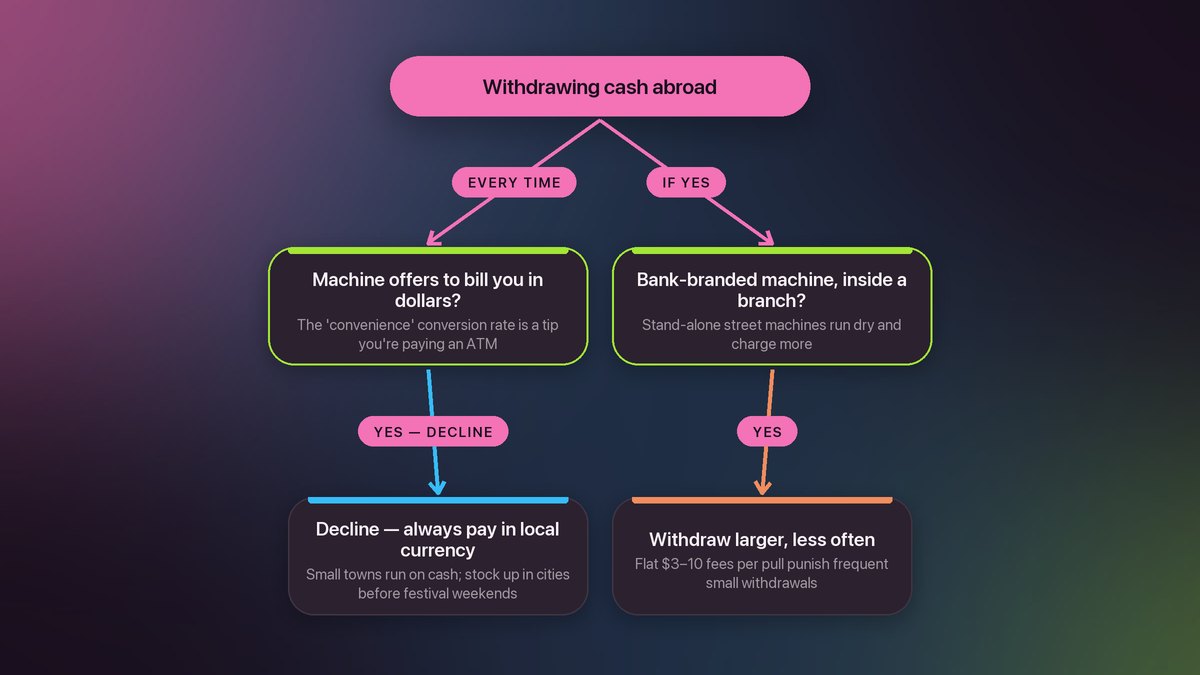
Across the Americas in 2026, money is card-first with cash islands, and the toolkit is settled by now. A credit card with no foreign-transaction fee, a debit card that rebates or at least minimises ATM fees, and a US-dollar emergency stash in clean small bills (yes, clean bills; a torn $20 is a negotiation you’ll lose), and honestly that’s the whole kit. ATM craft matters more than card choice, in my experience. Withdraw larger amounts less often, since flat fees of US$3–10 per pull are the regional norm. Use bank-branded machines inside branches during opening hours. And always decline when the machine offers to bill you in your home currency, because that “convenience” exchange rate is a tip you’re paying an ATM. Decline it. Small towns run on cash, and their machines run dry on festival weekends, so stock up in cities.
Argentina remains the special case. The old blue-dollar chaos has narrowed a lot since the 2023–24 reforms, and foreign cards now mostly settle at a fair rate, though the spread between cash, card and official rates still moves around. The traveller who checks the mechanics a week before arrival routinely saves 5–15% on the entire stay. That generalizes across the hemisphere, really. Exchange-rate mechanics are a moving target, and a quick “what did you actually pay at the ATM last month” from a recently returned traveller beats any static guide. This one included.
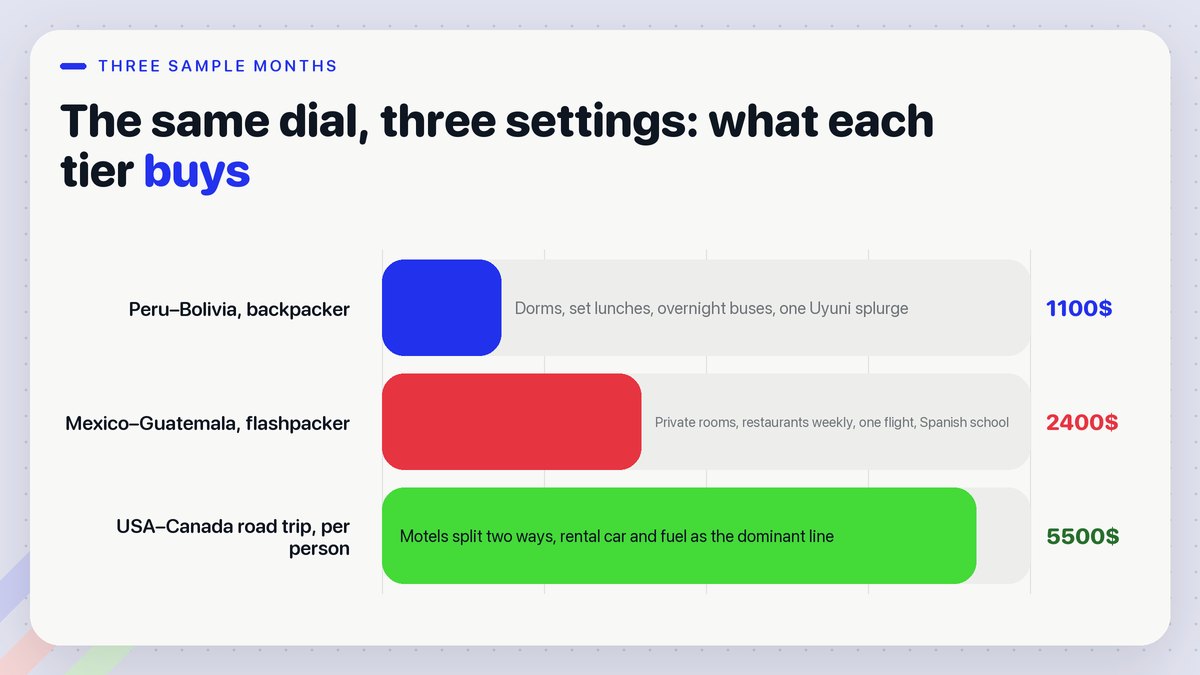
Three Sample Months What the tiers look like from inside
The US$1,100 month (Peru–Bolivia, backpacker). Dorms and family hospedajes, menú lunches and market dinners, overnight buses between regions, free hiking and ruins days, one deliberate splurge on the Salar de Uyuni loop, and a running tab of coca tea. Nothing about it feels like deprivation. It’s the trip people still describe years later.
US$2,400 a month (Mexico–Guatemala, flashpacker). Private rooms in guesthouses, comedores by day and restaurants a few nights a week, first-class buses plus one budget flight to skip the long haul, a week of Spanish school, several paid tours, and the occasional mezcal flight accounted for honestly. This is the tier where comfort stops being the story and the trip takes over.
A US$5,500 month (USA–Canada road trip, per person sharing). Motels and cabins split two ways, groceries and diners with a few destination restaurants, a rental car and fuel as the dominant line, national-park passes, and one paid anchor like a Banff gondola day. It’s the same dial as the other two, honestly. The month gets cheaper the slower it moves, and more memorable in the places where your money stretches furthest.
All figures are per-person estimates in USD as of mid-2026, based on reported traveller budgets and current price databases; exchange rates — Argentina’s especially — can move these numbers materially within months. International airfare and insurance are excluded. This article contains no affiliate links. All outbound links checked live in August 2026.