
History & Indigenous Cultures · The Maya World
The Maya never had an empire, never vanished, and never stayed inside the borders drawn over their homeland. Following their cities through Mexico, Guatemala, Belize, Honduras and El Salvador is the finest historical journey in the Americas — and far easier than it looks.
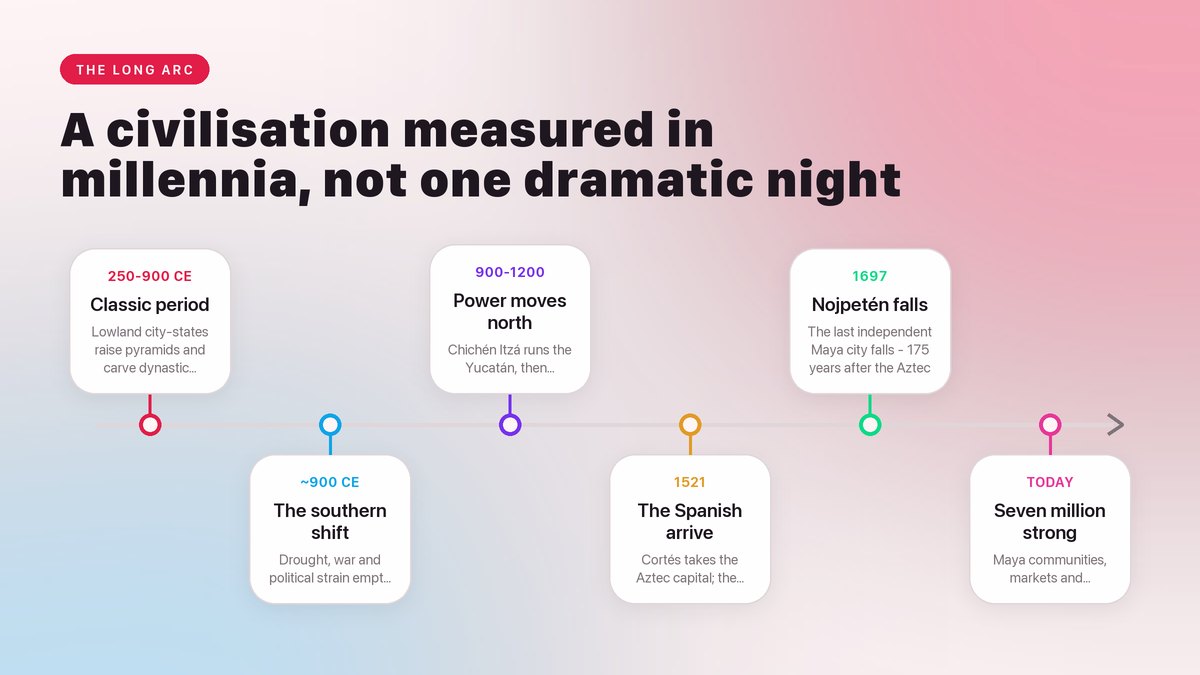
I’d begin with two corrections, because just about everything worth knowing about the Maya follows from them. The first is that the Maya never disappeared. The “mysterious collapse” that documentaries keep selling was the abandonment of certain southern lowland cities around 900 CE, a process that took generations rather than one dramatic night, and while those plazas emptied, millions of Maya people went on being Maya. They still are. Some seven million descendants live across the region today and speak thirty-odd Mayan languages, so the past tense is wrong more or less wherever you point it. The second correction is that the Maya were never an empire. They organised themselves as city-states that fought, allied, traded, occasionally conquered one another, which is why their homeland rewards a multi-country journey. No single capital to tick off. Just a constellation, spilling across five modern borders.
Tracing that constellation, from the tourist colossus of Chichén Itzá to jungle cities where howler monkeys outnumber visitors, is one of the great journeys on the planet, and honestly it’s more doable than the map suggests. What follows is how the pieces fit together, the order I’d see them in, and what changes, sometimes surprisingly, each time you cross a border.
In this article
- A Civilisation in One Paragraph The frame for everything you’ll see
- Mexico: The Famous North Yucatán, Chiapas, and the art of dodging crowds
- Guatemala: The Heartland Tikal, and everything beyond it
- Belize, Honduras, El Salvador The underrated three
- Reading the Stones How to actually see a Maya site
- Stringing It Together Routes and realities
- The Museums That Complete the Picture Where the best pieces actually live
- Deep Cuts for the Second Trip When the circuit hooks you
- The Living Maya The most important section of this article
- When to Go, and What to Carry The unglamorous logistics
A Civilisation in One Paragraph The frame for everything you’ll see
Maya civilisation came into its own during the Classic period, roughly 250–900 CE, when city-states across the lowlands raised temple pyramids and carved dynastic histories into standing stones. They also tracked Venus through the sky with an accuracy that still reads as showing off, and they produced the Americas’ only true pre-Columbian writing system. Because that system has now been substantially deciphered, these sites have changed character entirely; what used to be mute masonry is now readable history, with named kings and dated wars on the record. When drought, warfare and political strain emptied the southern cities, in proportions still argued over, the centre of gravity moved north, and Chichén Itzá, later Mayapán, ran the show until the Spanish arrived in the sixteenth century. The last independent Maya city, Nojpetén in Guatemala, only fell in 1697, a full 175 years after the Aztec capital. Sit with that date. Every site below is a chapter of the same long arc.
Mexico: The Famous North Yucatán, Chiapas, and the art of dodging crowds
Chichén Itzá earns its fame honestly. It’s a UNESCO site and one of the most visited ruins on Earth; the Castillo pyramid works as a calendar in stone, and the great ball court is the largest in Mesoamerica. In season it also swallows several thousand visitors a day, which changes the experience entirely. The strategy is simple. Sleep in Valladolid or Pisté the night before, be at the gate for the 8 a.m. opening, and reach the Castillo before the tour buses roll in from the coast around ten. Those two quiet hours are the whole game, and then you leave as the crowds are still arriving, which I’d argue is the correct move every time.
Palenque, in Chiapas, is the aesthete’s pick, a smaller, exquisite city half-swallowed by jungle. Pakal the Great’s tomb, found inside the Temple of the Inscriptions in 1952, proved to be the richest royal burial in the Americas. The UNESCO-listed site is compact enough to walk without hurry, the soundtrack comes from howler monkeys, and the on-site museum keeps Pakal’s magnificent funerary regalia close to the city it was dug from. Pair the visit with the waterfall circuit at Agua Azul and Misol-Ha on the way through. Both are worth the stop. My advice is two nights, not one, and I say that having watched plenty of people try to rush it.
Calakmul is the adventurer’s flagship, a superpower city-state and Tikal’s great rival, buried in a biosphere reserve near the Guatemala border. Sixty kilometres of jungle road. That drive filters out almost everyone. That’s rather the point. Climb Structure II, one of the largest Maya pyramids ever built, and the view is unbroken forest running into Guatemala, with other ruins showing as green swells on the horizon. The site and its forest carry joint World Heritage status. Jaguars live here, though you’re far more likely to meet spider monkeys, ocellated turkeys, and almost no other tourists. Base yourself in Xpujil and go at dawn, when the forest is coolest and the animals are moving.
And don’t sleep on the second rank. Uxmal and the Puuc route, an hour from Mérida, carry the most refined facades in Maya architecture. Ek Balam offers climbable pyramids and astonishing stucco work, and Cobá spreads through jungle between lakes, best explored by bike. The Mexican half of the Maya world justifies two weeks on its own, give or take, and that’s before you’ve crossed so much as one border.
Guatemala: The Heartland Tikal, and everything beyond it
Tikal is the one that makes people gasp out loud, and I count myself among them. Five temple pyramids rise above the jungle canopy, and the rooftop of Temple IV at dawn, mist moving through the treetops while the sun catches the crests, is one of travel’s canonical experiences; no exaggeration. Film fans know the view as the rebel base in the first Star Wars movie. The UNESCO-listed city held perhaps 60,000 people at its peak, and its plazas, its palaces, its carved stelae sprawl across sixteen square kilometres of protected forest loud with toucans and monkeys. Base in Flores, the island town on Lake Petén Itzá, take the earliest shuttle, and stay the full day, because most tours head back by two and the late afternoon belongs to whoever stayed. Bring water. The site is bigger than it looks.
Beyond Tikal, Guatemala keeps the connoisseur’s sites. Yaxhá, an hour away and maybe a tenth as visited, looks over its own lake at sunset. A tenth of the crowd. All of the view. El Mirador, the colossal pre-Classic city whose La Danta complex ranks among the largest pyramids anywhere by volume, asks for a two-day jungle trek or a helicopter. Quiriguá owns the tallest carved monoliths in the Maya world. In the highlands, the living Maya culture matters as much as any ruin, from the market at Chichicastenango to the cofradías of the villages around Lake Atitlán. Spend real time there and the past tense starts to dissolve on you.
Belize, Honduras, El Salvador The underrated three
Belize packs a startling number of major sites into a small, English-speaking country. Caracol, deep in the Chiquibul forest, was a city-state that beat Tikal in war, and its Caana pyramid still counts among the tallest structures in Belize. Xunantunich, reached by hand-cranked ferry, makes an easy half-day, with a climbable pyramid and border-country views. Lamanai, approached by riverboat through jungle, offers the most atmospheric arrival in the Maya world. Actun Tunichil Muknal, the ATM cave, is something else entirely, a guided, regulated swim-and-scramble into a ceremonial cave holding calcified sacrificial remains and intact ceramics, routinely called the most affecting archaeological experience in Central America. Book ahead. Daily numbers are capped, and they mean it.
Honduras holds Copán, and Copán holds the crown for art. Tikal impresses with scale; Copán stuns with detail, and I don’t think the comparison flatters either site. The Hieroglyphic Stairway carries the longest inscribed text in the pre-Columbian Americas, and the stelae, carved in the round with a sophistication specialists will happily compare to classical sculpture, reward slow looking. The UNESCO-listed ruin sits beside the town of Copán Ruinas, among the most pleasant small towns in Central America, and scarlet macaws, sacred to the Maya and reintroduced here, fly the valley at dawn and dusk. Give it two days. One isn’t enough.
El Salvador’s gift is different. Joya de Cerén, the “Pompeii of the Americas,” is where a volcanic eruption around 600 CE buried an ordinary farming village in ash and left homes, storehouses, a sauna, even food crops in the ground. No pyramids here. What you get instead is everyday Maya life frozen mid-meal, a necessary counterweight to all that royal stone, and it makes an easy day trip from San Salvador or Santa Ana, with the modest but pleasant Tazumal close by.
Reading the Stones How to actually see a Maya site
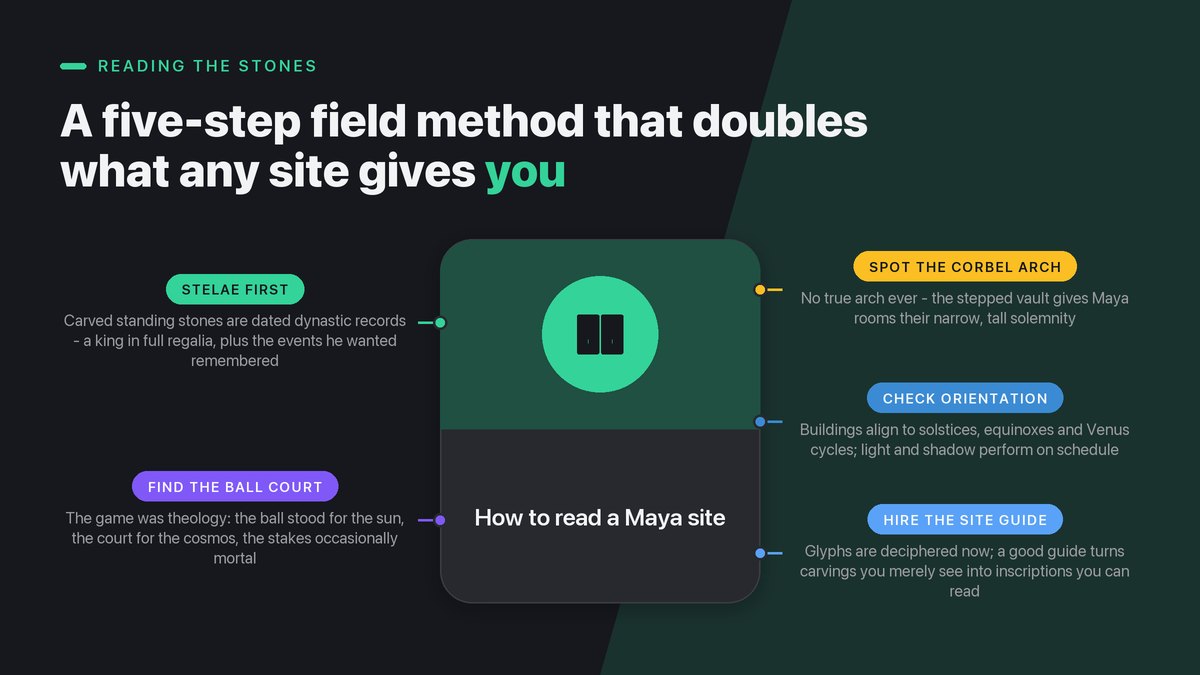
A short field method will roughly double what you take from every site. Start with the stelae, the carved standing stones that work as dated dynastic records, a king in full regalia surrounded by the events he wanted remembered. Find the ball court and picture the game as theology, with the ball standing in for the sun, the court for the cosmos and the stakes occasionally mortal. Look for the corbel arch, because the Maya never developed the true arch, and the stepped vault gives their rooms that narrow, tall solemnity you can’t quite name. Odd, and unmistakable. Note the orientation as well, since plenty of buildings align to solstices, equinoxes and Venus cycles; at Chichén Itzá on the equinoxes, light and shadow run a serpent down the Castillo’s stairway. Finally, hire the site guides where they exist, at Copán and Palenque especially. The glyphs have been deciphered, which means the sites can now speak, and a good guide makes them speak to you.
“The Maya never vanished. Seven million of them are still here, and the ruins were never a grave, only an archive, shelved in stone.”
Stringing It Together Routes and realities
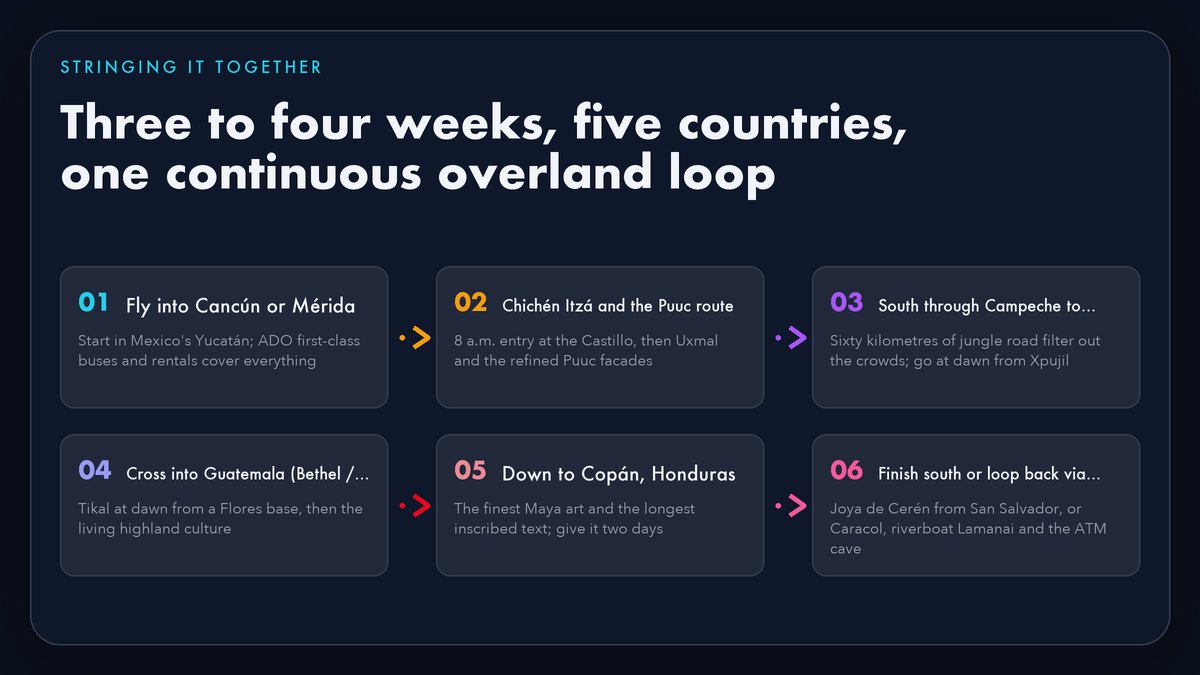
Plan on three to four weeks for the classic grand loop. Fly into Cancún or Mérida, do Chichén Itzá and the Puuc route, drop south through Campeche to Calakmul, cross into Guatemala by the Bethel or El Ceibo borders for Tikal, and continue down to Copán. From there you finish either out via San Salvador with Joya de Cerén tacked on, or back through Belize, where Caracol, Lamanai and the ATM cave pair naturally with Chetumal. First-class buses, ADO in Mexico, and the tourist shuttles that are everywhere in Guatemala and Belize cover every leg. The borders on this circuit are well worn and mostly painless. None of it requires a tour.
A few practical notes matter more than the rest. Season runs roughly November to April for the dry, comfortable window; May turns the lowlands brutally hot, and June through October brings rain, mud and mercifully thinner crowds. Cash still rules at site level in Guatemala, Honduras and El Salvador, where the ATMs cluster in hub towns, so carry small bills. Heat strategy is the one people skip, and it matters, because by noon the lowland sites are furnaces and the wildlife has gone quiet; dawn entries aren’t only about the crowds. Noon is brutal. On safety, the tourist corridors above are well travelled and generally calm, but conditions shift by region, so check advisories before each border (for US travellers, travel.state.gov) and ask locally about specific routes.
| Site | Country | Why it matters | Crowd level |
|---|---|---|---|
| Chichén Itzá | Mexico | The famous calendar-pyramid; Postclassic power | Heavy — go at 8 a.m. |
| Palenque | Mexico | Pakal’s tomb; jungle elegance | Moderate |
| Calakmul | Mexico | Superpower ruins in a living rainforest | Light |
| Tikal | Guatemala | The great Classic capital; dawn over the canopy | Moderate-heavy |
| Caracol & Lamanai | Belize | Tikal’s conqueror; the riverboat arrival | Light |
| Copán | Honduras | The finest Maya art and the longest text | Light-moderate |
| Joya de Cerén | El Salvador | Everyday Maya life, preserved by ash | Light |
The Museums That Complete the Picture Where the best pieces actually live
One hard truth of Maya travel is that the finest objects were moved into museums decades ago, and one hour in the right gallery changes what you see at every site. Budget the hour. Mexico City’s National Museum of Anthropology is non-negotiable, I mean that; the Maya halls alone justify the flight connection, with Pakal’s jade mask and the great stelae presented as art rather than inventory. Palenque’s site museum keeps the red-queen finds and a replica of the carved sarcophagus lid beside the jungle city they belong to. Copán’s Museum of Maya Sculpture, at the entrance, shows the original facades plus the full-size reconstruction of the Rosalila temple. That reconstruction is the jaw-dropping proof that these pyramids once screamed in red and green paint instead of the weathered grey we romanticise. The archaeology museum in Guatemala City and a handful of excellent private collections fill in Tikal’s story. Save Mérida’s Gran Museo del Mundo Maya for last if you can. It connects the ancient cities to the living culture better than anywhere else, and it sends you home understanding that the story has no ending, only a change of medium.
Deep Cuts for the Second Trip When the circuit hooks you
Almost everyone who finishes the grand loop starts planning the follow-up before it’s over, and I’m no exception; by about day ten the second list is writing itself. El Mirador by mule and foot takes two days each way through the Mirador basin, and the great pre-Classic cities seen the hard way are seen properly. Bonampak’s painted murals are the finest surviving Maya narrative art, deep in the Lacandón jungle and traditionally paired with riverside Yaxchilán, which you reach by boat. Yes, by boat. Río Bec flaunts its fantastical false-temple towers near Calakmul. Toniná piles up a towering acropolis outside Ocosingo. And in the highland ceremonial towns, Maximón still gets fed cigarettes and rum by candlelight. The Maya world is deep enough to absorb a lifetime of trips, and the five-country circuit is really only the orientation course.
The Living Maya The most important section of this article
At some point you’ll buy textiles from a Maya weaver, eat in a family-run comedor, or be led through a cave by a guide whose grandparents farmed beside it. Treat those encounters as the point of the trip, not the garnish. The highland markets are working institutions. Chichicastenango runs on Thursday and Sunday, Sololá on the quieter days. Ask before photographing people. Always. And pay fairly when you buy. If the itinerary allows, a community-run experience, perhaps a homestay on Lake Atitlán, a weaving cooperative in the Chiapas highlands, or a cacao workshop in Belize’s Toledo district, will teach you more than any ruin. The stones are magnificent, no question. But I’d argue the civilisation that built them is alive, and visiting it that way is both the respectful choice and the far more interesting one.
When to Go, and What to Carry The unglamorous logistics
The Maya world’s season is the dry season, roughly November to April, but the fine print matters more than the headline. Petén’s jungle, meaning Tikal and El Mirador country, walks easiest from February to April, before the May heat peaks and the June rains turn the trails to soup. The Yucatán works year-round, though March to May runs hottest and the cenotes earn their keep, and the Caribbean side keeps a hurricane watch from August into October. Highland Guatemala and Chiapas flip the logic entirely, busy and bright around Christmas and Easter, then mild and quiet in the green months, when the rain is mostly an afternoon appointment you can plan around. February is the sweet spot. Copán and the other lowland sites shine in the shoulder months, February especially, before the heat turns the plazas into ovens.
My field kit stays short, and I’d call every item on it non-negotiable. Carry more water than seems reasonable, because sites rarely sell it inside and a litre per person per half-day is the floor, which is to say you will drink all of it. Bring a real hat, long sleeves in quick-dry fabric, insect repellent you’ll actually reapply, and small bills for site fees and the guides at the gate, who are worth hiring at the major sites since they turn carvings you merely see into inscriptions you can read. Grip matters. Wear shoes with actual grip, because temple stairways are steep, worn, and polished to a shine by a thousand years of feet. One habit improves every site, and that’s arriving at opening. The first two hours hold the cool air, the wildlife, the best light, the smallest crowds, and at Tikal the dawn chorus of howler monkeys is the main event, maybe the point of the trip. The traveller who shows up at 8 a.m. and the one who shows up at noon are, more or less, visiting different ruins.
Site hours, cave-tour caps and border formalities change; confirm current arrangements in each hub town. Security conditions vary across the five countries; consult current official advisories before travel. This article contains no affiliate links. All outbound links checked live in August 2026.
Keep reading
 History & Indigenous CulturesThe Ancient Cliff Dwellings of the American Southwest: A Practical Guide to Mesa Verde and Beyond
 History & Indigenous CulturesColonial Architecture of the Americas: Reading Cities Through Their Buildings
 History & Indigenous CulturesIndigenous Tourism Done Right: How to Visit Without Extracting