
Road Trips & Overland · USA
The Mother Road turned one hundred this year. It was officially decommissioned four decades ago, and somewhere between those two facts sits the truth about what a Route 66 trip actually is in 2026, and why this is the year to take it.
On April 30, 1926, a telegram sent from Springfield, Missouri, settled an argument between two states and gave a new federal highway its number: 66. A hundred years later to the day, on April 30, 2026, Springfield threw the road a birthday party, the official national kick-off of a centennial year that has pulled caravans, festivals and a small army of nostalgics onto a highway that, technically speaking, no longer exists.
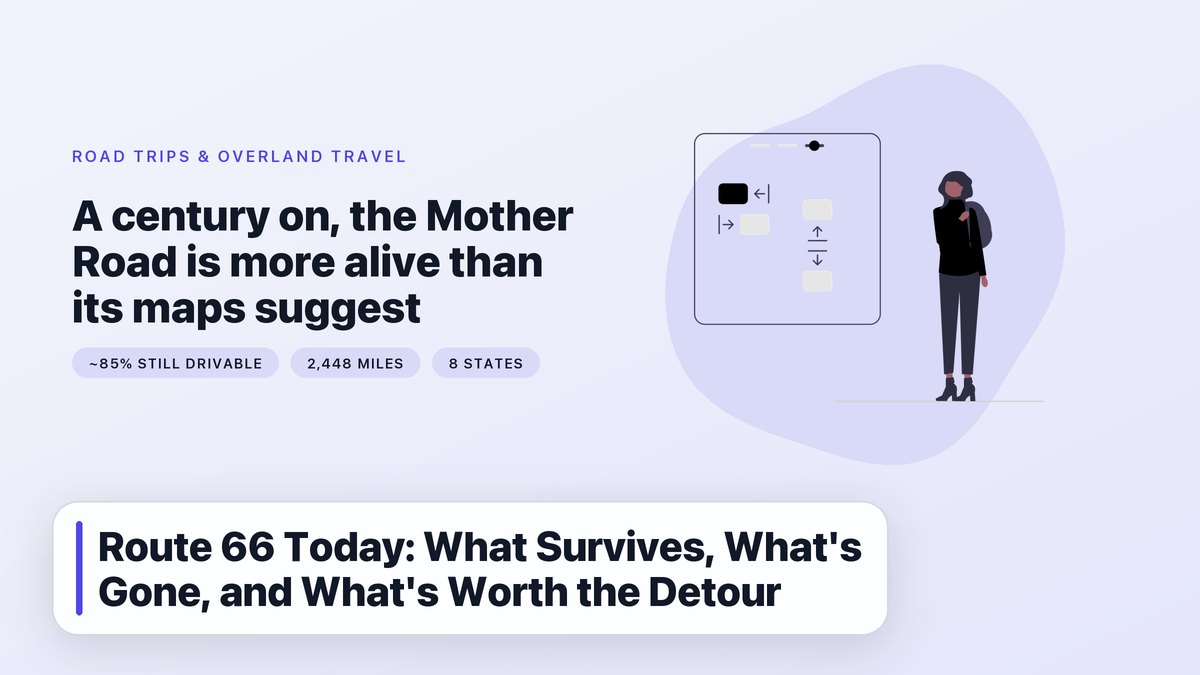
That tension is the story. Route 66 left the US highway system in 1985, its purpose eaten by five interstates, yet roughly 85 percent of the original 2,448 miles between Chicago and Santa Monica is still drivable, and the road has never carried more meaning. If you’ve been waiting for a reason, the centennial year is the best one there’s ever going to be. What follows is an honest account of what’s out there.
In this article
- What “Driving Route 66” Means Now A scavenger hunt, not a highway
- What Survives More than you’d think
- What’s Gone Say this part plainly
- The Centennial Year Why 2026 is different
- State by State: The Short Version
- The Detours That Are Worth It And one philosophical rule
- Practical Notes for the Drive Things the songs skip
- Reading the Road Alignments, shields and the art of not getting lost
- Where to Sleep The motor court strategy
- The Verdict Is it worth it, a century on?
- Eating the Mother Road The preservation success nobody catalogued
What “Driving Route 66” Means Now A scavenger hunt, not a highway
First, shed the idea of a single continuous road. Route 66 was realigned dozens of times during its life, so there are several different 66s, a 1930s alignment here and a postwar one there, and long stretches where the old road is buried under, beside, or broken into pieces around Interstate 40. Driving it today means following turn-by-turn guides or one of the dedicated navigation apps, threading frontage roads and main streets, and now and then standing on an abandoned concrete ribbon in the grass while trucks roar past a hundred yards away. Old pavement, basically, stitched through the modern map. That abandonment is part of the pleasure, too. 66 is the rare road trip where the road itself is the attraction.
I’d budget two weeks for the full drive at a humane pace. Ten days works if you’re disciplined, three weeks if you like museums and long breakfasts. I said two weeks, and I’ll stand by it, though honestly if museums are your thing make it three. You can rush the drive in less, but I’d advise against it, because rushing a road whose entire point is slowness kind of misses the joke.
What Survives More than you’d think
The surviving fabric of 66 falls into a few glorious categories, and the best days on the road stitch all of them together.
Towns that kept the faith. Seligman, Arizona, is where the historic-preservation movement for 66 effectively began, in a barber shop, and it remains the spiritual capital, a strip of neon and merchandise that somehow stays charming. Williams and Winslow are worth your time (yes, that corner; there’s a statue and a park, and yes, you’ll stop). Tucumcari keeps an improbable strip of surviving motels, and Pontiac, Illinois, has its museum cluster; give Pontiac an hour, maybe ninety minutes. All of them wear the road proudly.
The roadside giants. The Blue Whale of Catoosa, Oklahoma, got a new visitor centre for the centennial, and it deserves one. Then there’s the Cadillac Ranch outside Amarillo, the giant rocking chair in Missouri, and the Wigwam Motels in Holbrook and San Bernardino, where you can still sleep in a concrete teepee. Mid-century America’s idea of advertising ages beautifully, it turns out.
Diners and motor courts, still working. Dozens survive in operation: the Midpoint Cafe in Adrian, Texas, at the exact halfway mark; the Cozy Dog Drive In in Springfield, Illinois, which claims the corn dog’s invention; the 66 Diner in Albuquerque. These are working restaurants rather than exhibits, so order the pie.
The country itself. The road crosses eight states and just about every western biome there is: Illinois corn, Ozark hills, Oklahoma prairie, Texas Panhandle sky, New Mexico’s high desert, Arizona’s painted country, and the Mojave before the last tumble into Los Angeles. The National Park Service’s Travel Route 66 program maps the nationally significant sites along the corridor, and Petrified Forest National Park in Arizona preserves the only piece of original Route 66 pavement inside a national park.
What’s Gone Say this part plainly
For every glowing survivor there are a dozen ghosts, and this part deserves plain talk. Whole towns are ruins or near-ruins: Glenrio on the Texas–New Mexico line, Two Guns and Dilia in Arizona, their gas stations and courts going back to the desert. Vast stretches of Illinois and Missouri are just modern road with historic signs, and some famous stops are fenced, closed, or reduced to a foundation and a plaque. The interstate didn’t simply bypass these places; in many cases it took their economy with it. The quieter loss, still in progress, is the passing of the generation that ran the mother-road businesses. Some closures still sting.
So how should you think about the road now? I’d say it’s part road trip, part open-air archive, and part act of patronage, because every meal in a surviving diner and every night in a family-run motor court is a small vote for the road’s continued existence. That’s not sentimentality. It’s how the remaining places actually survive, and centennial-year attention has already pushed several restorations from dream to ribbon-cutting.
“Route 66 today is part road trip, part open-air archive, part act of patronage. Every night in a family-run motor court is a vote for the road’s survival.”

The Centennial Year Why 2026 is different
The hundredth birthday has organized the road like nothing since decommissioning. Springfield’s April 30 kick-off anchored a year of events strung across all eight states: a national caravan that drove the full route in June, vintage rallies, a record-breaking classic-car cruise in Tulsa, Amarillo’s ten-day Texas Route 66 Festival, Albuquerque’s celebrations at the only spot where the original and later alignments cross, and Santa Monica’s ceremonies at the road’s symbolic end. State associations from Illinois to California have used the year to pay for signage, restore neon, and reopen landmarks. The calendar is stuffed.
Practically speaking, 2026 is probably the busiest year the road has seen in decades. The classic motor courts book out on event weekends, and the famous stretches (Seligman, Tucumcari, the Sitgreaves Pass through Oatman) run busy. If you’re driving this year, book the iconic sleeps well ahead. The Wigwams, the Blue Swallow in Tucumcari, and the Rail Haven in Springfield go first. If you’re driving later, take heart, because the centennial’s real gift is freshly restored neon and a dozen revived landmarks that will outlast the party. Which is good news if you’re reading this after the crowds go home. The National Historic Route 66 Federation keeps guides and news for the corridor year-round.
State by State: The Short Version
| State | Miles | Don’t miss | Watch for |
|---|---|---|---|
| Illinois | ~300 | Chicago’s Adams Street sign; Pontiac’s museums; Springfield’s Cozy Dog | Best signage on the route, easiest state to follow |
| Missouri | ~290 | Springfield (birthplace of the name); Meramec Caverns; Cuba’s murals | Ozark curves, the old road still drives like 1938 |
| Kansas | ~13 | Galena’s stretch; Cars on the Route | Blink and you cross it, worth the hour |
| Oklahoma | ~400 | Blue Whale; Route 66 Museum in Clinton; Tulsa’s neon | Longest drivable stretch; the road at its purest |
| Texas | ~180 | Cadillac Ranch; Midpoint Cafe; U-Drop Inn at Shamrock | Panhandle wind and 6 p.m. small-town closing times |
| New Mexico | ~380 | Tucumcari’s motels; Santa Fe loop; Albuquerque’s Central Ave | Two alignments, the pre-1937 Santa Fe loop is the scenic one |
| Arizona | ~390 | Seligman; Sitgreaves Pass & Oatman; Petrified Forest; Winslow | The best driving on the route, and the hottest |
| California | ~320 | Amboy’s Roy’s Motel sign; Mojave ghosts; Santa Monica Pier | Desert distances, fuel and water discipline |

The Detours That Are Worth It And one philosophical rule
The pure-66 purist misses some of America’s best scenery by a hundred miles. Take the accepted great detours instead: the Grand Canyon, an hour north of Williams (if you’re that close, go), Santa Fe and Taos by way of the pre-1937 alignment, Monument Valley far north in the Navajo Nation, and Las Vegas, which sits visible from the route, is spiritually its opposite, and works as a palate cleanser for exactly that reason. My rule is simpler. Route 66 is a state of mind more than a compliance exercise, and since the road’s own history is a tangle of realignments, yours can be too.
Practical Notes for the Drive Things the songs skip
Navigation. Cell coverage dies across the western deserts, so download offline maps and carry a printed turn-by-turn guide. Illinois and Oklahoma sign their alignments best; in other states the signage gets thin, and GPS will constantly try to drag you back to the interstate.
The car. Any reliable vehicle can do it, because the road is paved end to end. A classic car is glorious and also hot, thirsty, and slow, and an August breakdown in the desert is no joke, so if you rent vintage, do it for a segment with support behind you. Whatever you drive, start desert days early, carry water, and buy fuel when you can rather than when you must.
Season. Late spring and early autumn are ideal. Summer brings serious heat across Texas, New Mexico, Arizona and the Mojave, plus monsoon storms in Arizona in July and August, and winter snow can close the high country in New Mexico and northern Arizona.
Cost. This is still one of America’s great budget road trips. Motor courts and mom-and-pop motels run US$60–120, diners keep portions honest, and the attractions are mostly free or nearly so. Two weeks, two people, comfortable pace, call it US$2,500–4,000 plus the vehicle.
Pace. Two hundred miles a day on the old alignments is a full, happy day. Slower is the point. The interstate brain will scream that you’re wasting time, that screaming feeling is the medicine.
Reading the Road Alignments, shields and the art of not getting lost
Part of the fun is learning to see the road’s layers. The brown “Historic Route 66” shields posted by the states mark the main tourist corridor, but the older alignments keep appearing if you know what to look for: a dead-end strip of Portland cement with the original 1920s expansion joints, a narrow concrete road running fifty yards off the modern one, a bridge too narrow for modern trucks now serving a farmhouse driveway. Oklahoma and Illinois mark their alignments best; California’s Mojave stretch barely marks anything, and the reward for following the guide precisely is standing on pavement that carried Steinbeck’s Joads. The mythology has a bibliography worth packing. Steinbeck’s The Grapes of Wrath named it the Mother Road, the 1946 song made it singable, and the 1960s TV series made it cool, and reading the Okie migration chapters while you drive the Oklahoma-to-California stretch turns the scenery into the story it actually is. (The song, by the way, is why everyone knows the number; the TV show is why their parents do.) 66 was, among other things, the road of the largest internal migration in American history, and the abandoned motor courts read differently once you remember they were built for families fleeing the Dust Bowl with everything they owned in the back seat.
Where to Sleep The motor court strategy
Accommodation on 66 splits three ways: the historic (bookable, characterful, occasionally drafty), the ordinary (chain motels in the bigger towns), and the resurrected, which is the centennial’s best trend, with long-closed motor courts restored by preservation-minded owners. The strategy that works is to anchor the trip with the icons (a Wigwam night, the Blue Swallow in Tucumcari, a rail-car or caboose room somewhere, one of the grand old downtown hotels in Tulsa or Albuquerque) and fill the gaps with whatever mom-and-pop motel has cars in the lot, which remains the eternal quality signal. Book the icons early. Most of the route runs US$60–120, give or take, and double that for the famous few in centennial season. Campers and RVs are well served by state parks and classic roadside campgrounds, and a tent night in the desert states gets you the Milky Way the neon was built to compete with.
The Verdict Is it worth it, a century on?
If you need every stop to be a polished attraction, no. Drive a national park loop instead. But if you want to understand the twentieth century’s great American migration, eat pie where the Dust Bowl refugees ate pie, and watch the desert claim a gas station in real time before drinking a milkshake in one that refused to die, there is nothing else like it. The centennial didn’t create the road’s meaning; it gave everyone a deadline to go feel it. The neon’s lit, get your kicks while it is.
Eating the Mother Road The preservation success nobody catalogued
The buildings get the heritage attention, but the restaurants are the most alive part of the survival story, and planning a drive around them is half the fun. In Illinois, that means a Cozy Dog in Springfield, ancestral home of the corn dog, and the horseshoe, an open-faced monument to excess that no visitor finishes. Missouri answers with frozen custard at Ted Drewes in St. Louis, serving since 1929, a line out the door in February, and Oklahoma counters with fried pies and chicken-fried steak in cafes where the coffee refills are automatic and the waitresses call you honey regardless of your demographic.
Then the road climbs onto the plains and the food becomes legend management. The Midpoint Café in Adrian, Texas, is exactly halfway, as the sign insists, and serves what may be the most photographed pie in America. Amarillo’s Big Texan is the other stop: the 72-ounce steak is free if you eat it inside an hour, and the theatre of watching someone try is the real meal. New Mexico changes the whole palette, green chile on everything, and you will be asked “red or green?”; the right answer the first time is “Christmas,” meaning both. By Arizona you’re back in pie-and-coffee diner country, and California ends it at a Santa Monica pier where the correct order is something fried, eaten looking at the Pacific you just earned. My rule for the whole road is to eat where the cars out front are old, local, and dusty. It has not failed yet.
Two footnotes. First, breakfast is the road’s most reliable meal: the diners open early, the coffee is bottomless by constitution, and the morning crowd (farmers, truckers, the occasional fellow pilgrim with a guidebook on the formica) is the cheapest live entertainment in America. Second, the trading posts and gift shops deserve their own line, because they’re the road’s retail ecosystem; the good ones, and you know them by the local cars out front, sell regional artists’ work and the kind of roadside kitsch that becomes oddly precious later. Buying from them is how a two-lane economy stays alive between the festivals. So skip the airport souvenir on the way home. The thing you want is in a turquoise-fronted shop in Arizona, and it costs eight dollars.

Centennial event details reflect announcements published through August 2026; individual business hours on the route are fluid, so call ahead to any diner or motor court you care about. Alignment mileages are approximate and depend on routing choices. This article contains no affiliate links, and all outbound links were checked live in August 2026.
Keep reading
 Road Trips & Overland TravelThe Blue Ridge Parkway: A Practical Guide to Driving Appalachia’s Scenic Spine
 Road Trips & Overland TravelThe Utah National Parks Road Trip: A Practical Guide to the Mighty Five
 Road Trips & Overland TravelThe Pacific Coast Highway: A Practical Guide to Driving California’s Highway 1