
Destination Guides · Mexico
Roughly four in five international visitors to Mexico never leave the coasts. Meanwhile, an hour or two inland from the airports they flew into sits one of the great collections of historic cities on Earth, and most of them are cheaper than the beach.
Ask a first-timer to picture Mexico and you’ll get a beach. Always the beach. Cancún’s hotel strip, Los Cabos, the all-inclusive corridor of the Riviera Maya. Ask a Mexican where they take visiting relatives and the answer is far more likely to be a plaza than anything with a wristband policy. Guanajuato’s Jardín de la Unión at dusk. Oaxaca’s zócalo under the laurel trees. The pink cantera glow of Morelia’s cathedral once the light starts to go. These interior cities are where Mexico actually lives, and they remain strangely invisible to the resort crowd that dominates the tourism numbers.
This guide is about that other Mexico. The colonial cities of the Bajío and the south, what each one is actually like, how to string them together by bus, and the practical questions (safety, altitude, cost) that keep people from going. The short version: the hesitations are mostly outdated, the buses are excellent, and a week of plazas, markets and mole will run you less than three nights at a mid-range all-inclusive.
In this article
- Why the Interior Is Different A country the coast doesn’t show you
- The Bajío Circuit The easy first loop
- The Southern Pair Oaxaca and Puebla, the food capitals
- Getting Between Them The bus is the answer
- The Safety Question, Answered Properly What the headlines miss
- Practical Realities Altitude, timing, money
- Where to Go Deeper When the loop isn’t enough
- Southeast Alternative: Mérida and Campeche The colonial loop nobody flies home talking about
- Where to Stay and How to Behave Small choices, better trip
- The Honest Objections And whether they hold up
- A Two-Week Route, Day by Day The circuit, scheduled
Why the Interior Is Different A country the coast doesn’t show you
The coastal resorts were built for visitors, in a lot of cases on empty coastline, within living memory. The colonial cities were built for Mexico, as mining capitals, religious centres and seats of power across three centuries of Spanish rule, layered on top of Indigenous civilisations that never went away. That layering is the whole attraction. In Oaxaca you can stand in a Zapotec ceremonial centre in the morning (Monte Albán is twenty minutes from town), eat pre-Hispanic ingredients at lunch, and walk home past a baroque church raised partly from the stones of older temples.
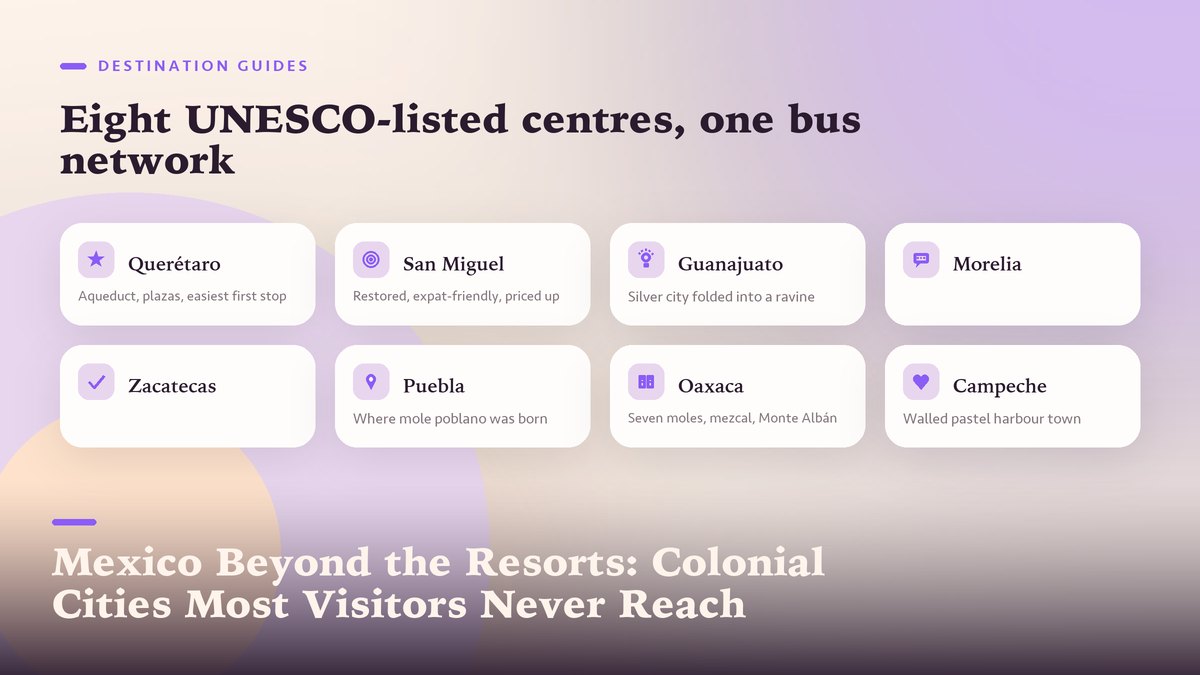
UNESCO noticed, even if the package-tour industry hasn’t. All eight of them. The historic centres of Oaxaca, Puebla, Guanajuato, Morelia, Zacatecas, Querétaro, San Miguel de Allende and Campeche all sit on the World Heritage list together, which is a density of recognised historic centres that few countries on Earth can match. Not one of them asks you to wear a swimsuit.
The Bajío Circuit The easy first loop
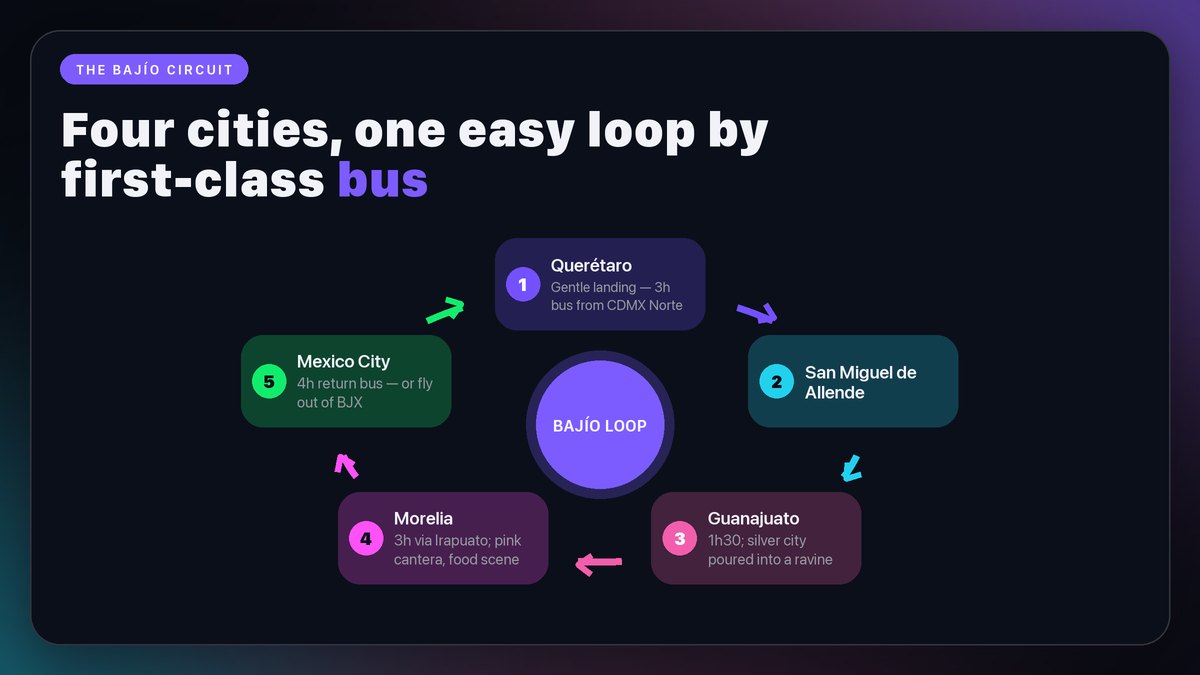
The Bajío, the high plateau northwest of Mexico City, is where independence began and where the colonial architecture reaches its most theatrical, all of it packed into a region you can cross in an afternoon. Four cities make a natural loop, each one two to four hours from the next on a first-class bus, which means you never have to pack a suitcase for more than a morning.
Guanajuato
Physically the most improbable city in the Americas. No contest. A silver boomtown poured into a ravine so narrow that the roads run underground through the former river tunnels, leaving the surface mostly to pedestrians and the staircases to your calves. Ride the funicular up to the Pípila monument, follow the estudiantina musicians on their singalong procession through the alleys at night, and see the mummies if your taste runs that way. Guanajuato is the one that converts people. Three nights minimum. It’s a university city, which keeps it cheap and loud in the good way, and its October Cervantino festival is the biggest arts event in Latin America. Book six months ahead if that’s your target.
San Miguel de Allende
San Miguel sits barely an hour from Guanajuato by bus, yet the atmosphere is a world away. Immaculately restored, home to a large American and Canadian expat community, priced to match. The neo-Gothic parish church is the postcard; the real pleasure is the rooftop restaurants and the gallery scene. For nervous first-timers it’s the softest entry point on this list. English is common, the infrastructure is polished, and I’d argue it’s the least “undiscovered” place in this article, which is a fair trade for how easy it makes everything. Two days is the right dose. Calibrate your budget expectations before you book, not after.
Morelia
The one that should be famous and isn’t. No idea why. Morelia’s centre is built from warm pink cantera stone, hundreds of blocks of it, anchored by a cathedral that took a century to finish. It’s a state capital with a serious food scene, this being Michoacán, one of the great culinary regions of Mexico, and it sees a fraction of San Miguel’s foreign foot traffic, partly because nobody has bothered to market it to you. In November it doubles as the base for the monarch butterfly reserves in the mountains to the east, one of the genuine natural wonders of the hemisphere.
Querétaro and Zacatecas
Querétaro’s historic centre is the calm, tidy outlier of the loop. An aqueduct on one side, plazas at its heart, and an easy first or last stop given how close it sits to Mexico City. Zacatecas, further north, is the dramatic pick. A mining city folded into a mountain bowl, a cable car swinging over the rooftops to the Cerro de la Bufa, and a cathedral facade that specialists rank among the finest examples of Mexican baroque anywhere. It takes more effort to reach, which is exactly why it still feels like a discovery.
The Southern Pair Oaxaca and Puebla, the food capitals
If the Bajío is architecture first, the south is food first. The architecture is no consolation prize either.
Oaxaca got fashionable over the past decade, internationally so, and the attention is earned. Seven kinds of mole. Mezcal palenques sending up smoke in the valley villages. The vast Tlacolula Sunday market, alebrije workshops in Arrazola, Monte Albán on its mountain terrace above the whole thing. The prettiest blocks have turned expensive by interior standards, so stay a few streets back from the zócalo, where the rooms cost half as much and the moles taste identical. Give it four nights and make one of them a cooking class. Oaxaca’s are the best in the country.
Puebla, two hours from Mexico City, is the undersung giant. A big, proud city of talavera-tiled facades where mole poblano and chiles en nogada were born, and where lunch can take the better part of an afternoon if you let it. The historic centre is enormous, the museums are first-rate (the Amparo especially), and from the hills of Cholula next door you get volcano views of the sort you’d expect a queue for. There is no queue. A church sits planted on top of the largest pyramid base on Earth, and you can simply walk up.
“The coast shows you a Mexico built for you. The interior shows you Mexico. You’ll eat better in the second one.”
Getting Between Them The bus is the answer
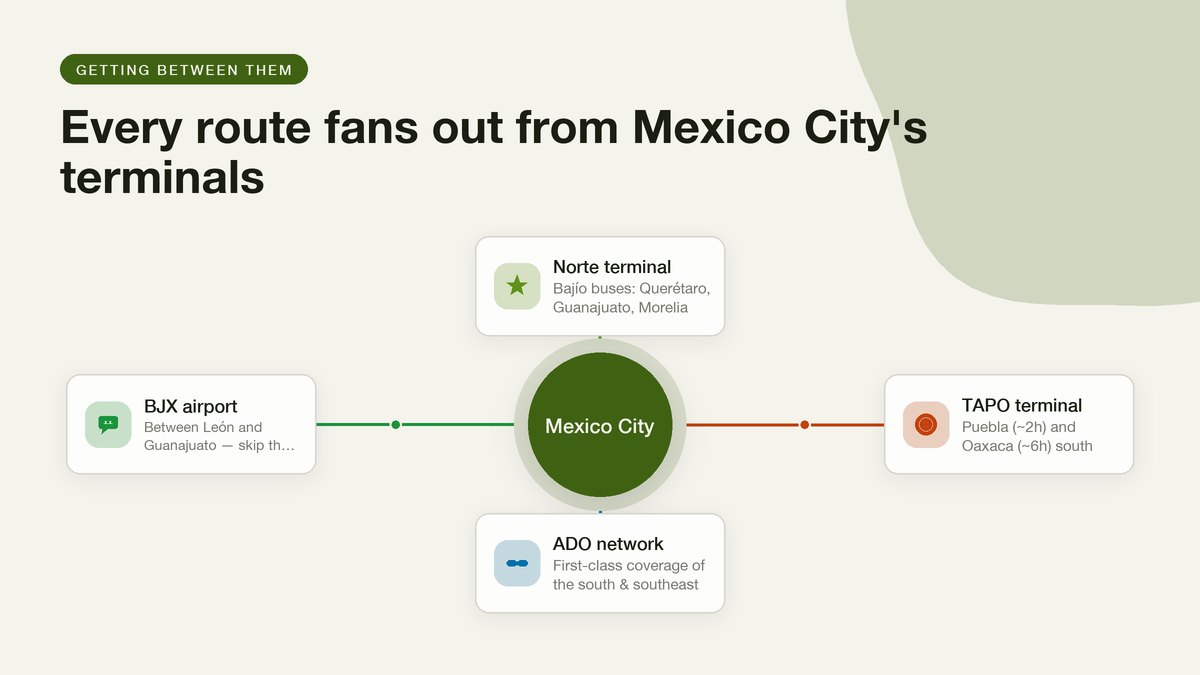
Mexico’s first-class and executive bus network is one of the underappreciated travel systems of the world. Assigned reclining seats, air conditioning, onboard toilets, scheduled rest stops, and departures that run like rail services. ETN and Primera Plus cover the Bajío while ADO covers the south and southeast, and between them they run the whole circuit in daylight hours with seats you can actually sleep in. Fares between Bajío cities run roughly US$15–35 depending on distance and class. Book online or just walk into the terminal. Outside holiday weeks, same-day tickets are rarely a problem.
The capital runs four bus terminals, each serving a different direction, and you’ll use Norte for the Bajío and TAPO for Puebla and Oaxaca on nearly every itinerary of this kind. If the big city doesn’t appeal, Bajío International Airport between León and Guanajuato lets you skip it entirely, which plenty of first-timers do. My advice: leave the car out of this circuit. The historic centres are walkable, parking is a headache, and the buses are simply better. Simple as that.
| Days | Base | Bus leg to get there |
|---|---|---|
| 1–3 | Querétaro | 3h from CDMX Norte terminal |
| 3–5 | San Miguel de Allende | 1h15 from Querétaro |
| 5–8 | Guanajuato | 1h30 from San Miguel |
| 8–10 | Morelia | 3h from Guanajuato (via Irapuato) |
| 10 | Return | 4h back to CDMX, or fly out of BJX |
The Safety Question, Answered Properly What the headlines miss
Mexico’s security situation is real, regional, and badly reported. The violence that dominates coverage is concentrated in specific trafficking corridors and particular states, and it overwhelmingly does not target tourists, which is why the colonial heartland sees ordinary, manageable, big-city risk rather than anything out of the ordinary. Watch your phone on crowded buses, take registered taxis or ride-hailing at night, don’t flash cash at markets. That’s it. That’s the list.
Two qualifications, stated honestly. Conditions vary by state and they do change, so check the current advisory level for your specific states (not just “Mexico” overall) on the US State Department’s travel site before booking, and note that it grades Mexican states individually. Road travel after dark is the other thing to avoid in the interior, which the bus network conveniently solves, because day buses cover every route in this article in daylight.
Practical Realities Altitude, timing, money
Altitude. Much of this circuit sits between 1,800 and 2,400 metres. Most visitors feel nothing worse than getting winded on Guanajuato’s stairs, and Guanajuato has a lot of stairs. Arrive hydrated, keep the first day’s margaritas moderate, and take the funicular up the Pípila hill instead of proving something, because the altitude doesn’t care about your training regimen.
Timing. The highlands are temperate year-round, warm days and cool nights almost without exception, with a rainy season from June to September that delivers its rain in late-afternoon bursts rather than all-day washouts. October and November are the glory months, with clear skies, marigolds and Day of the Dead. Oaxaca and the Pátzcuaro region near Morelia are the two great destinations for it, and both need bookings months ahead. Semana Santa and Christmas week fill everything with domestic tourists, which is lovely or maddening depending on your tolerance for crowds.
Money. Cards work in hotels and restaurants. Cash everywhere else. Markets, street food and small-town comedores are cash economies, so carry pesos. The interior is dramatically cheaper than the coast: a very comfortable double room in Morelia or Zacatecas runs US$40–70, a market lunch US$4–6, and even San Miguel’s inflated prices look modest next to Tulum’s.
Language. Outside San Miguel and Oaxaca’s centre, English drops off fast. Basic Spanish changes the trip, not because people are unkind to non-speakers (they aren’t), but because the best of these cities happens in markets, fondas and conversations that need it. Nothing fancy. Twenty phrases is all it takes to get a different restaurant, a different price, a different afternoon.
Where to Go Deeper When the loop isn’t enough
If the circuit whets your appetite, the interior keeps unfolding. Mérida, the Yucatán’s gracious capital, pairs with Campeche’s walled pastel centre as a full alternative to the Riviera Maya. Guadalajara, all mariachi and tequila country next door plus a magnificent historic core, is a major city that somehow stays off foreign itineraries. Real de Catorce, a half-ghost silver town at the end of a long tunnel bored through a mountain, has the single most cinematic arrival in the country. And Pátzcuaro, an hour from Morelia, is the soul of Michoacán: adobe, tile roofs, lake canoes, and the most moving Day of the Dead in Mexico.
For current opening hours and any access changes at the archaeological sites near these cities (Monte Albán, Cholula, the museum network), the federal anthropology institute INAH maintains the authoritative listings.
Southeast Alternative: Mérida and Campeche The colonial loop nobody flies home talking about
If your flights point at Cancún anyway, the Yucatán holds its own colonial answer to the resort strip. Mérida, the “White City”, is a proud, safe, deeply liveable state capital. Mansions line the Paseo de Montejo, the plazas host free cultural events most nights, and the food runs to cochinita pibil and sopa de lima rather than hotel buffets. It also makes the ideal base for Uxmal and the Puuc ruins an hour south. Easy day trips. Campeche, two hours southwest, is the walled, pastel-painted harbour town the pirates forced Spain to fortify. UNESCO-listed, it receives a fraction of Mérida’s visitors and repays an overnight with its malecón sunsets and fortress museums. Travellers who split a Yucatán week between the beach and these two cities routinely call the interior days the better half.
Where to Stay and How to Behave Small choices, better trip
Lodging in these cities sorts into three bands. Hostels and simple posadas at US$15–35. The converted colonial mansions that are the region’s signature mid-range, US$50–120 for courtyards, high ceilings and rooftop terraces. And a growing boutique tier above that. Book the mansion hotels, they’re the point of the trip, and favour a spot within three or four blocks of the main plaza, where the evening life concentrates and walking home after dark feels comfortable. A few habits carry real weight in the interior. Small stuff, mostly. Greet shopkeepers when you walk in, a simple “buenos días” changes every interaction. Ask before photographing market vendors and their stalls. Dress a notch more formally than on the coast, where the interior reads shorts and flip-flops as beach costume. And learn the comida corrida rhythm: the main meal is lunch, roughly 2 to 4 p.m., when set menus give the day’s best value and the cities close down for a couple of hours to enjoy it. (Yes, the midday shutdown surprises first-timers. Lean into it. That’s what the rooftop terrace is for.)
The Honest Objections And whether they hold up
“I don’t speak Spanish.” Workable, with effort, in San Miguel and Oaxaca; harder elsewhere. Learn the basics and go anyway.
A week is more than it sounds. “I only have a week” still leaves room for three cities, Querétaro, Guanajuato and Morelia, done slowly, and three done slowly beats six done in buses, it’s not close.
“The beach is why I go to Mexico.” Fair enough. Consider the split trip though: a week in the interior, a few coastal days at the end. Oaxaca city to the Oaxacan coast (Puerto Escondido, Huatulco) is a short flight or a spectacular mountain drive, and it settles the argument by giving you both.
None of this means giving up the beach forever. The resorts will survive without you for a week. The Mexico they’ll never show you is sitting on a plaza bench a few hours inland, at about 6,000 feet, with the cathedral bells going and something on the grill that no swim-up bar serves. Go find out which mole is yours.
A Two-Week Route, Day by Day The circuit, scheduled
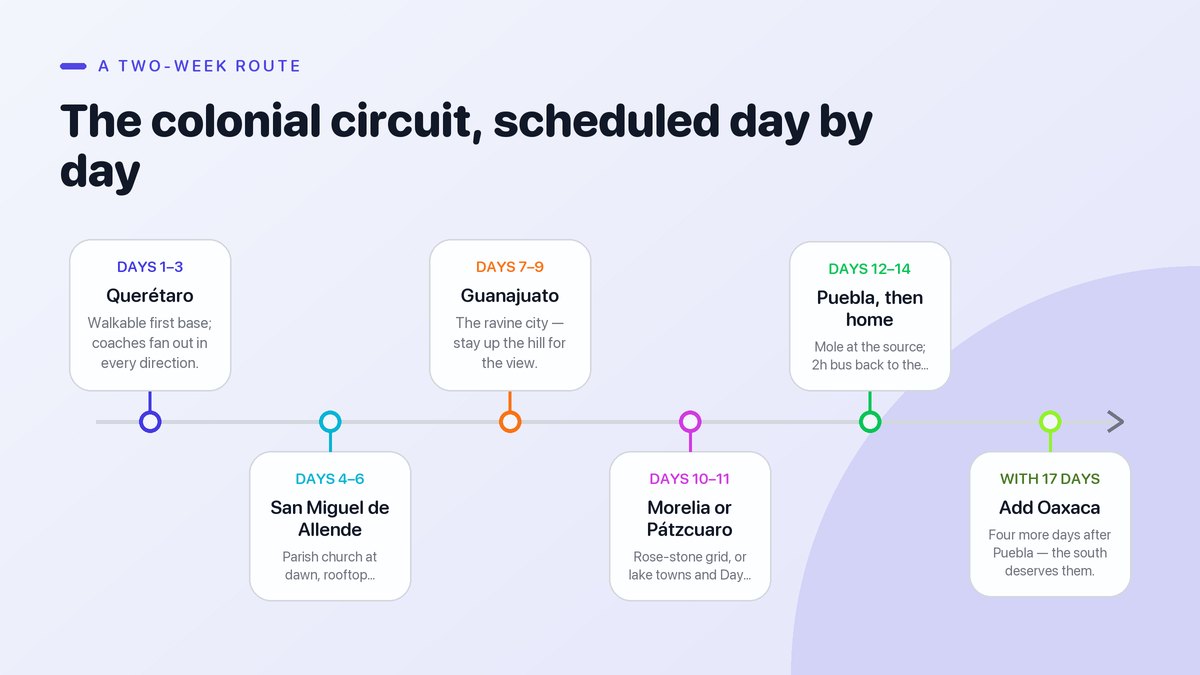
Put the loop on a calendar. Fly into Mexico City and get straight out to the interior. Days 1–3, Querétaro. Underrated, walkable, the gentlest landing you could ask for, and the first-class coaches fan out from here in every direction. Days 4–6, San Miguel de Allende. Yes, it’s polished and half-expat. It’s also genuinely beautiful, and three days is the right dose, long enough for the parish church at dawn and the rooftop dinners, short enough to leave before the boutiques blur together. Days 7–9, Guanajuato. The one people love hardest. A university city folded into a ravine, alleys instead of streets, the Callejón del Beso and the mummies if your taste runs that way. Stay up the hill for the view and ride the funicular home after dinner.
Days 10–11, Morelia or Pátzcuaro. The choice is city versus lake. Morelia’s rose-stone cathedral grid and candy market, or Pátzcuaro’s plaza and the Purepecha lake towns. Around Day of the Dead you book a year ahead and accept the crowds as the price of the real thing. Days 12–14, Puebla and home via Mexico City. Come hungry. Puebla earns its ending: mole at the source, the talavera workshops, the Capilla del Rosario’s impossible gilding, then an easy two-hour bus back to the capital’s airport. With seventeen days instead of fourteen, bolt Oaxaca on after Puebla rather than squeezing it in, because the south deserves its own four days and the route that tries to do everything in two weeks ends up remembering mostly bus stations. I’ll say it plainly: in Mexico’s interior every move costs you a half-day, so the winning number is five bases instead of eight.
Bus companies, routes and prices referenced reflect schedules in effect in mid-2026 and shift seasonally; verify at the terminal or the operators’ sites before travel. Security conditions vary by state and over time — consult current official advisories before booking. This article contains no affiliate links. All outbound links checked live in August 2026.
Keep reading
 Destination GuidesCalifornia’s Desert Parks by Car: A Practical Guide to Joshua Tree, Death Valley, and the Mojave Preserve
 Destination GuidesNewfoundland and Labrador by Car: A Practical Guide to the Viking Trail and Beyond
 Destination GuidesGreat Smoky Mountains National Park: A Practical Guide to America’s Most Visited Park